

Toys That May Encourage Pretend Play
Now we’re going to list some toys that might encourage pretending. You don’t need all of them, and they don’t have to be fancy or expensive. Some of them you may be able to make yourself, like a dollhouse with 2 or 3 rooms out of cardboard boxes that you tape together.
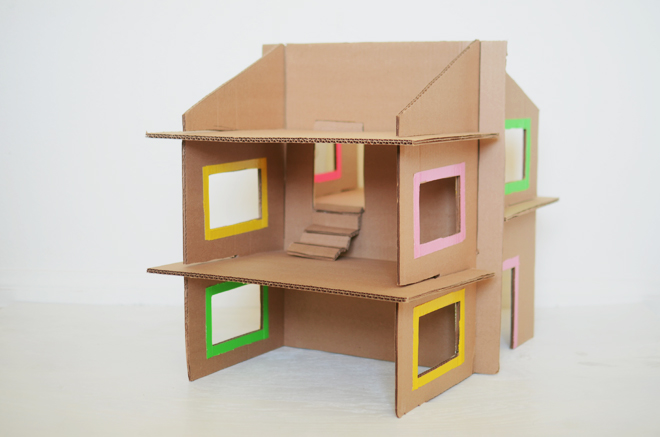
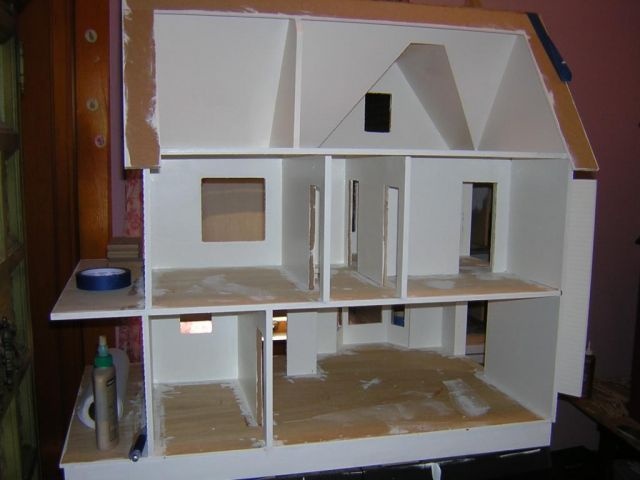
The Pinterest website is a great place to find ideas. You can find many examples for how to make toy kitchens, dollhouses, and even dolls. Keep in mind, however, that the more the toy looks like the real thing, the easier it will be for the child to learn to pretend with it.
When you decide on a play scene to start with, make sure it’s one the child is familiar with. For example, feeding a baby doll is a good action to teach, especially for children with a baby brother or sister. But, if your child has seldom seen a real baby drinking from a bottle, that may not be a good one for him. Think about some of the simple things your child sees adults or other children do often. For example, sharing a pot of tea, stirring a pot of food, feeding a baby, talking on the telephone, or driving a car might be good things to start with.
STEP 1: ONE-STEP SIMPLE TOY PLAY WITH THE CHILD AS THE ACTOR
Let’s start with the first type of play skill: One-step simple toy play with the child as the actor. You could start with a baby doll that your child can pretend to feed. Or you could start by pretending to eat a toy food, or pretending to stir something in a small pot with a spoon. You might want to start by putting a couple of sets of things on a table or on the floor in front of your child. These could be things like a baby with a baby bottle, and a pot with a spoon. Does she seem to show more interest in one set of toys? It’s always a good idea to use materials that your child seems interested in. This will make it more likely that she will want to play with you. It will also keep her attention longer.
Be on the lookout for toys that your child finds interesting and that can be used for pretend play.
This is a really important point, so let’s repeat it. Be on the lookout for toys that your child finds interesting and that can be used for pretend play. Toy foods, a doll, a stuffed animal, a toy car or truck are all good toys to try out. There are lots of toys that your child may like a lot but that can’t readily be used for pretending, like toys that light up or spin. We suggest you put those out of sight while you’re working on pretend play, and just have toys that are good for pretend play available.
You can start in the child’s play area if she has one or in the child’s special learning space if you have set one up (as we discussed in Module 9). Or you could work on pretending to feed a baby doll while sitting at the kitchen table just before or after a meal. You could pretend to bathe a baby doll in the bathroom just after your child’s bath or pretend to put a teddy bear to sleep just before, during, or after your child’s bedtime routine.
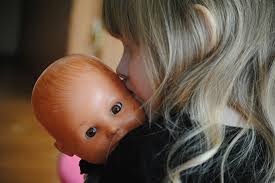
Let’s say your child showed some interest in the baby bottle. Put the bottle and the baby doll on the table or floor in front of her. If she doesn’t pick up the doll after about 5-10 seconds, you pick it up and say, “Let’s feed the baby.” Then cradle the baby in your arms or keep it in front of your child and pretend to feed it for a few seconds, making baby drinking noises. Then hand the child the bottle and say something like, “Now you feed the baby,” or “Now it’s your turn to feed the baby,” or “The baby’s hungry.”
If the child makes no move to do so, gently help her to hold the baby and/or to feed it. If the child puts the bottle in the wrong place (like in the baby’s eye or ear), help her move the bottle to the mouth and say, “Bottle goes in baby’s mouth.” Or just move the doll so that the bottle goes near the doll’s mouth. Then, whether you helped or not, provide enthusiastic praise. You could say, “What a good mommy” (or “daddy”). You fed the baby.” Or you could make enthusiastic baby drinking noises and then tell her how happy the baby is to have his bottle. Then try to extend the play for a short time, in whatever way you like. For example, you could say, ‘Now baby’s ready for bed’ and cover the doll with a small blanket. Or make the baby cry and say, “Oh no! Baby’s hungry again.” Then prompt the child to feed the baby again. Or you could try burping the baby or feeding it with a spoon instead of a bottle.
If your child responds well and enjoys the activity, even for only a few minutes at a time, continue to try out new ideas. Remember to pretend things that your child will have done himself or have seen others do as a part of familiar routines.
In the next clip, the little boy’s mother and teacher encourage him to feed a stuffed toy buffalo and he catches on quickly. After a physical prompt, the little boy responds right away to just a gesture/point prompt with some verbal cues. And later, he does it a couple of times all by himself. His mother periodically goes back to physical prompts to help remind him of what to do. She reinforces him with happy eating noises and sometimes she claps for him. He is clearly starting to enjoy the play. This kind of shared or joint engagement is such an important social building block.
If your child starts a new line of pretend play with these toys or seems to want to continue with the same theme, it is important to follow her lead enthusiastically. However, after a few minutes of play like this, if you sense that she’s done, you should move on to another pleasant activity. This could be something like going outside, having a snack, or blowing bubbles. In the next clip, watch how the teacher tries to keep the child interested in pretend play with a doll. After a minute or two, it’s clear the little boy has lost interest. So she switches gears and uses the baby blanket to begin a game of peek-a-boo. That way, she is able to keep him engaged and having fun.
Remember, keeping the child engaged is very important and play should be fun. It’s especially important not to push too much and run the risk of turning it into a chore or making it boring. Try to give your child at least 3-4 short chances to learn pretend play each day, using a few simple sets of toys. Follow the short play sessions with an activity you know she likes. This will also help her view the pretend play sessions as something she likes.
Play should be FUN; so don’t push too much and run the risk of turning it into a chore.
It’s fine to continue with this sort of activity a few times a day, even if the child doesn’t seem interested at first. Just keep each play time short and fun. Don’t push the child too hard to copy what you’re doing. If your child seems to dislike this kind of play or tries to get away each time, discontinue it for a few weeks and then try again.
STEP 2: MULTI-STEP TOY PLAY WITH THE CHILD AS THE ACTOR
What if your child has learned to do 2 or 3 simple pretend acts, like feeding the doll, pretending to eat toy food or drink from an empty cup, say hello into a telephone, or stir a pot. Now it’s time for you to move on to step two. Step 2 is teaching a longer sequence of pretend actions. Let’s take the example of feeding the baby. After your child has learned to feed the baby, put a piece of cloth (like a cloth diaper, dishtowel, or paper towel) next to the doll. Wait a few seconds to see what your child does. Does she pick it up and use it to wipe the baby, cover the baby, or burp the baby? If not, just show her how to do one of these things. Then hand the baby doll to your child and gently prompt her to do the same thing. Keep it to two actions for now, like feeding and then burping the baby. If your child learns this sequence pretty easily, then you can move on to 3 or even 4 steps. These could be actions like feeding baby, burping baby, wiping baby’s mouth, putting baby down for a nap and covering the baby with a blanket.

Show how much fun this kind of play can be. Do this by showing a lot of positive emotion. Or do something funny, like pretending baby burped up “yucky” milk on your shirt. You want to show not only how to pretend, but also that it’s fun. This point really can’t be said too strongly: Be sure to make this play fun. As another example, when your child burps the baby, she may find it funny if you make a loud burping sound for the baby. Say something like “Oh! Baby made a loud burp. You did a good job burping him.” Or, “Oh, no! Baby is still hungry! The bottle’s empty, let’s find something else to feed baby.” Then rush around looking for a cookie, toy food, a baby’s bowl and spoon, or another bottle.
Be sure to try out several different pretend play sequences. These could be things like feeding the baby, cooking, serving and eating something. If you have some empty cereal or cookie boxes or milk cartons, you could put them on a low bookshelf or table and pretend to go shopping. Then, if you want to get really ambitious, you could cook, serve and eat the food you bought! The object is not to teach one specific set of actions, but for the child to learn the IDEA of pretending, and to enjoy it. And sooner or later she should be able to pretend different sequences of events. And remember; go with what the child is interested in. That will make her learning much easier and more fun.
STEP 3: SIMPLE TOY PLAY WITH A DOLL OR STUFFED ANIMAL AS ACTOR
The next step is for your child to learn to play by making the dolls do things. She could make them run, eat, talk, play, hug, sleep, etc. Like we did with pretend play where the child is the actor, start simply and then add more steps. You can also start with a routine that the child seems to understand or enjoy when she does it herself, like eating, or bathing. Use small dolls and maybe a doll house, which you can make yourself. You can have the Mommy or Daddy doll be the one who feeds the baby, instead of having the child do it herself. Or perhaps the Mommy doll can take the baby doll for a walk in the stroller if you have a small toy stroller.
Here are some other simple play scenes that you could model for your child. You could walk a doll up a set of stairs made of blocks to go to bed. You could have two stuffed animals or dolls say hello and hug each other. Or you could make them dance to music. You could have the mommy or daddy doll hold a spoon and stir a pot. You could even make a baby doll add a block to a block tower or put a piece into a puzzle. Then you would gently prompt the child to make the doll do those things. This does not seem hard to us. But it’s actually a big leap in thinking for the child to understand that she can pretend to make a doll or figure come to life and act out familiar scenes. It may take a while for your child to learn to make the dolls, action figures, or stuffed animals come alive to do things. But as long as she’s enjoying the activity, you can continue showing, and prompting. And, of course, reinforce her efforts by enthusiastically helping with this play. When she is able to do one or two steps in this way, try to extend the play to a longer sequence of steps, which is step 4.
STEP 4: MULTI-STEP PLAY WITH A DOLL OR STUFFED ANIMAL AS ACTOR
Once your child learns how to play by having a doll, figure, or stuffed animal do things, you can extend this to a sequence. For example, the mommy doll can stir a pot, spoon something from the pot onto a plate and give it to the baby doll to eat. Or the mommy or daddy doll can walk to the “store” (a shoe box labeled “STORE”), buy something, walk home to the kitchen and put it on the table. Or you could pretend the parent doll is washing the child doll in the tub, saying something like, “Oh my! You got so dirty playing! Let’s get you nice and clean.”
When you model these sequences, it’s a good idea to change the details at least a little each time. You want to show your child that the pretend play doesn’t have to be the same each time. Use a lot of positive emotion, fun, and enthusiasm. Then invite your child to play with you. Say things like, “Can you help the doll walk up the stairs?” “Can you make the mommy put the baby in the bathtub and give her a bath?” Then, gently help the child do the action you mentioned. It doesn’t matter how much help you need to give your child. Praise her enthusiastically. Again, don’t carry on for too long or the child may get bored or frustrated. This should always be fun, and if possible, followed by a fun activity, like going on swings, having a snack, or blowing bubbles.
Next: Expanding Play Skills To New Situations & Using Naturally Occurring Reinforcers