

Expanding Play Skills To New Situations & Using Naturally Occurring Reinforcers
Expanding Play Skills To New Situations
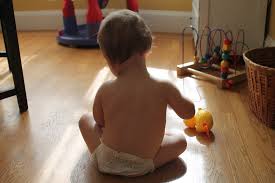
Here’s another important point about learning to pretend. You want your child to know that she can have fun pretending anywhere. So, after she’s learned a pretend play skill, try to do it in other places in your house. Involve other adults or children. Have them play with her using these toys. When an adult learns to drive a car, we hope she can then pretty easily use those skills to drive a different car. And we want her to be able to drive in a new neighborhood. In the same way, we want the child to learn to play with a variety of toys, and then be able to play with them in different places and with different people. We’ve discussed this before; it’s called generalization.
Sometimes, the child will find it fun to try pretending while an adult is doing the real thing. For example, if possible, let the child practice stirring her toy pot while an adult is actually cooking in the kitchen. Make a big fuss over what a good job she’s doing cooking while you or another adult is cooking too. If you’re washing dishes, hammering a nail to hang a picture, or raking leaves in the yard, the child could be pretending to wash small plastic dishes, hammering something with a toy hammer, or raking leaves with a child-sized rake, next to you.
USING NATURALLY OCCURRING REINFORCERS
We’ve talked in earlier sections about what kinds of reinforcers (rewards) you can use when your child is learning new skills. These could be food treats, tickles, praise, or favorite activities like bubbles. You may have seen that in this section, we didn’t talk much about using rewards like treats, tickles, or bubbles for doing nice pretend play.
When you teach pretend play, it is especially important to use what we call naturally occurring or natural reinforcers. Those are rewards that are part of the activity itself, rather than an unrelated activity or treat, like bubbles or a food treat. An example of a natural reinforcer would be if your child offers you a bite of a toy cookie. Rather than interrupt that nice pretend play with a new activity like bubbles, you could extend the play with a funny, enthusiastic response, like “ooh, yum, that is delicious, thank you for the cookie – and here’s one for you!” This keeps the play going. It teaches the child the idea of a sequence of steps. And it’s also the kind of reward the child is likely to get from other adults and children when she is playing with them. You might have noticed in an earlier clip that after the little boy pretended to feed a baby doll, the teacher had the baby doll pretend to kiss him on his cheeks and then his tummy. This was another way of rewarding him for playing so well with the doll. And of course, praise, and sometimes tickles, are always fine too, as long they don’t stop the flow of the pretend play.
RESOURCES:
There are other parts of play, especially play with other children, which we haven’t discussed in this program. These include taking turns, following rules, being able to lose a game without getting upset, and many others. Instead, we concentrated here on the earliest kinds of play. These early play skills are important for later social and thinking skills, especially the ability to pretend. If you are interested in more mature pretend, like role playing some occupations (firefighter, doctor, chef, etc.) and the other play skills that we mentioned in the beginning of this module as numbers 5 and 6, there are many great resources. Here are a few of them:
|
A FINAL NOTE:
There’s a general rule for teaching all children new skills. This holds whether it’s learning words, learning movement skills like throwing a ball, or learning self-help like putting on socks or tying shoes. The rule applies to children with typical development as well as with developmental conditions: Think about what your child can do in that skill area. Then, try to start just a tiny bit above that level. For example, if your child has no pretend play, you would want to teach the simplest kind of pretend play, and not something more advanced like role play. If your child has a lot of single words but no word combinations, you could try to teach simple two-word combinations (mommy eat, throw ball or want cookie). But you would not start with full sentences right away.
Always think about where your child is and help him to make the next baby step. Baby steps add up to big strides!
Now we are going to ask you some questions about what you have learned. As with the quizzes at the end of other sections, these questions are ways for you to test yourself to see if you need to read the section again, and the questions are also additional learning opportunities. Some of the questions will have choices and some will be true or false questions. A good way to work on these questions is to read the question, think about the answer, make your best guess and then read the explanation of the correct answer. There will be 10 questions. If you answer all of the questions correctly, you are probably ready to try out some of the suggestions we have made in this section. However, if some of the questions were difficult for you, or, if you answered them all correctly but feel you could benefit from reading the section again, please do.