

What Maintains Problem Behavior Involving Picky Eating?
Remember how throughout these programs we’ve talked over and over about reinforcement? Reinforcement is the process of strengthening a behavior by rewarding it. For example, when your child makes eye contact with you, and you smile back at him, give him a little tickle or maybe even a little treat, the smile, tickle, or treat is the reinforcer. By rewarding him for making eye contact, you’ve made it more likely that he’ll make eye contact with you in the future. In this way, things that reinforce behavior help to maintain or increase the behavior. In the case of problem behavior associated with eating, we must look for things that might be reinforcing the problem behavior.
There are several possibilities including:
|
Parents are understandably worried if they think a child is not getting good nutrition. You want your child to be a ‘good eater.’ So if your child has a tantrum when you try to get him to eat an apple or a carrot, you may quickly try to soothe him, remove the apple or carrot and give him some food he likes instead, so that he’ll calm down and eat enough. In this case, we have three possible reinforcers maintaining the tantrum behavior. First, you’re paying a lot of attention to him. Second, you’re removing the food he doesn’t want and you’re no longer asking him to try it. Third, he’s getting the foods he likes. Another thing that might happen is that because you don’t want him to get too upset, you let him leave the highchair or the table without eating.
Of course none of us mean or intend to reinforce problem behavior in our children… most of the time, we don’t even realize we are doing it!
Allowing the child to escape from a situation he doesn’t like when he has a tantrum is a sure way to reinforce tantrums. None of us mean to reinforce problem behavior in our children, but every single one of us can think of times that we have done it. Most of the time, we don’t even realize we are doing it! And we never want to force children to eat anything they don’t want to eat. So, it’s best to change the way we present new foods, and we will talk about that later in this module.
Finally, young children often like to be in control of the situation. Eating is one of the few things young children can really control. They may not be able to avoid going to the doctor to get a shot, or whether they get to go to the playground that day. But they can control what goes into their mouths!
Food stirs up strong feelings, both good and bad. For this reason, children have very strong desires to be in control of their eating. And, as we said before, some children with autism can have especially strong desires to be in control. They often get upset when things don’t go as they expected.
Let’s review the most common reinforcers for problem behavior associated with eating:
|
See if you can figure out if any of these things usually occur when your child reacts with problem behavior at mealtimes. Do you rush to soothe your child and give him his favorite foods? Do you get angry and frustrated, and pay a lot of negative attention to the tantrum? Do you allow him to leave the table? If your child is engaging in a lot of problem behavior related to eating, and you would like to try to make some changes that will help him to eat better, with less problem behavior, we are going to give you some suggestions. However, we recommend that you don’t try to introduce any new foods for a while. Instead, we suggest what we call a “cool-down” period.
Before You Start: A Cool-Down Period
Let’s say your child is very rigid about food and becomes very upset when he’s presented with unfamiliar foods or foods he doesn’t like. If this becomes happens frequently during mealtimes, it’s probably a good idea to have a cool-down period for a couple of weeks before you begin encouraging him to try new foods again. During this time, offer him choices of only those foods you know he likes and is likely to accept. You will probably see much less problem behavior. This means that there will be a time when your child is not being reinforced for the problem behavior that tends to happen at mealtime.
Using the Cool Down Period
For example, say that you notice that whenever you put unfamiliar foods in your child’s plate he has an immediate tantrum, and that you then remove the food from his plate to calm him down. By avoiding this situation altogether for a while, you will not be giving him opportunities to practice and strengthen this tantrum behavior. Later you will try to increase the number of foods he will accept by offering new foods he’s never seen before.
Remember, even negative attention can be a reinforcer.
Or, say that you think your child may be reinforced by all of the attention he gets when he tantrums over new foods. Remember, even negative attention can be a reinforcer. In that case, by taking a break from trying new foods, you’re taking away the chance for him to get extra attention for tantrums. Then you can focus on giving him some extra positive attention for accepting bites of foods you know he likes. This way, accepting food gets reinforced, and refusing food does not get reinforced.

Here’s another example of how you can use this cool-down period. Say that you notice that your child begins to fuss a lot when he’s finished eating or when you give him less preferred foods. When he gets upset, you let him leave the table. What you may be doing is reinforcing the fussiness. So what should you do? Feed your child his familiar foods. Watch carefully so you see when he’s slowing down and getting full. As you see that, prompt him to ask you in whatever good way he can, to leave the table, before he becomes fussy. If he can’t speak yet, use a picture (see Module 13 on Picture Exchange Communication system), or even a sign, like “all done,”. Then just end his meal before he becomes upset.
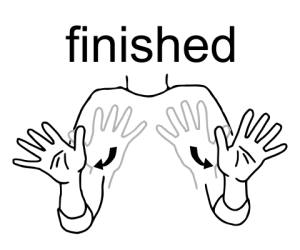
You can say “all done?” while showing him how to make the sign. Then gently help him make the sign, while you say, “All done! Good asking! Let’s go play!” Then, help him out of his highchair or seat right away. The goal here is to stop the problem behavior before it gets started. You are replacing it with better communication so that mealtimes can become a more pleasant experience.