

Imitating Sounds and Words
Imitating Sounds
Now we’re going to talk about how to teach your child to imitate sounds. We suggest you begin with two easy sounds, which are very different from one another; such as Aaaah and Mmmm. Both sounds are relatively easy to produce and they require that your mouth be in very different positions. This should make it a little easier for your child to see and hear the difference between the two sounds. The Aaaah sound is very easy to make, as you need only open your mouth wide and say, “Aaaah.” The Mmmm sound is also easy to make because you only need to close your mouth, put your lips together, and say, “Mmmm.”
You may have already worked on oral motor imitation. Oral motor imitation is imitating movements of the mouth. If so, and your child can do this pretty easily, then hopefully adding sound will not be too difficult. However, the production of sound can be more difficult to prompt successfully. Most of the behaviors we have talked about thus far are easy to prompt. For example, when you prompt a child to clap, you can help him to do it well the very first time he tries. But speech often needs to be “shaped” over time.
You may have worked on eye contact in this way. We usually need to reward better and better eye contact over time. This is called “shaping eye contact.” We do this because, at first, many children don’t make eye contact for more than a second. We call this fleeting eye contact. So, we have to start there. Over time, we require just a second or two longer before reinforcing eye contact. We call this “sustained” eye contact. Working on speech is similar. We have to reinforce better and better tries to make the sounds you want the child to make.
Minimize Frustration by Mixing in Trials of Skills Your Child Knows Well
When we begin to work on verbal imitation, we want to make it as easy as we can. This helps to prevent frustration or to keep it to a minimum. One way to do this is to mix in trials of motor imitation or one-step instructions that your child has already learned. This way, your child will be successful at least half of the time with little or no help. Also, beginning and ending each set of trials with something easy should help to build your child’s confidence. Making sure that your child is earning frequent access to reinforcement. This will help to keep him motivated to try something new. You want him to keep trying, even if it doesn’t come easy for him.
Did you notice that in the clip you just watched, when the teacher wants the child to repeat the sounds she makes, she begins with the word, “say.”. For example, she gives the instruction, “Say, Aaaah” or “Say, Mmmmm.” Remember to say the word “say” very softly. Then, pause briefly before you begin to make the sound you want the child to imitate. Use a slightly louder voice when you make those sounds. It is important to put the emphasis on the sound and not on the word “say”. This is because we don’t want the child to repeat the word “say.” We want him to repeat only the sound that comes after the word “say”.
Present Teaching Trials in an Unpredictable Order
Be sure to present trials of vocal imitation, mixed in with trials of motor imitation or one-step instructions, in an order than is not predictable. Let’s start with the sounds, “Aaaah” and “Mmmm.” Here are some examples of orders of teaching trials that might work well. They follow no specific pattern and so they are not predictable.
| Sample Order 1 | Sample Order 2 | Sample Order 3 |
| Clap | Arms Up | Clap |
| Arms up | Mmmm | Aaaah |
| Aaaah | Clap | Clap |
| Mmmm | Mmmm | Arms up |
| Arms up | Clap | Aaaah |
| Aaaah | Aaaah | Arms up |
| Clap | Aaaah | Mmmm |
| Mmmm | Arms up | Clap |
| Aaaah | Mmmm | Mmmm |
| Arms up | Clap | Aaaah |
Try working on these two new sounds, mixed in with two motor imitation movements or one step instructions that your child has mastered. The new sounds should be practiced for about half of your trials. It is fine to mix it up a little. If you practice this three times a day, using the three different orders suggested above, your child will get to practice each new sound more than 20 times in the day. And, at the same time, he will be practicing motor imitation and/or one-step instructions which should help to keep those skills fresh.
Provide Frequent Reinforcement & End on a Positive Note
When first teaching vocal imitation, make sure that your child never goes for more than two trials without receiving reinforcement. If your child does not produce a sound correctly, simply break eye contact. Then pause for about three seconds before you present the next trial. Try not to do vocal imitation more than twice in a row unless your child is successful.
If he has been unsuccessful twice, always do a motor imitation or one-step instruction trial next. That way, things stay positive. If your child does not respond to a motor imitation or one-step instruction correctly within approximately three seconds, prompt the response you have asked for. Then reinforce him for his prompted response.
Try not to do vocal imitation more than twice in a row unless your child is successful. If he has been unsuccessful twice, always do a motor imitation or one-step instruction trial so that he can be successful and things stay positive.
And here’s something else: try to always end a set of 10 trials on a positive note. So, if your last trial is a vocal imitation sound and your child responds correctly, that’s great! But if he responds incorrectly, or does not respond at all, add at least one more trial. Make sure it’s a motor imitation or one-step instruction trial. That way, he will be successful. Even if your child doesn’t respond, you can prompt the correct response and then reinforce the prompted response. That way, you can guarantee that the set of trials will end with success.
If Your Child Isn’t Making Progress, Drop Back to Teaching Only One Sound
Begin teaching your child vocal imitation, practicing two sounds several times a day as described above. If he makes little or no progress in a couple of weeks, try dropping back to only one sound. Drop back to one sound even if you see progress but he still seems frustrated. Try the sound, “Aaaah” mixed in with any two motor imitation movements and/or one-step instructions your child is very good at. Present the trials in an order that is not predictable. Make sure to present the Aaaah sound in only about 4 out of every 10 trials. For the rest of the trials, ask him to imitate actions he is very good at imitating. Or you can ask him to follow instructions he is very good at following. You want him to be successful, all by himself, more often than not.
If your child enjoys lollipops, you could hold out a lollipop and reinforce your child’s efforts with licks of the lollipop. You saw a teacher do this in a previous clip. The lollipop may also work as a prompt for your child to open his mouth. If so, you may have better luck getting him to produce the Aaaah sound.
If your child is not able to imitate your sounds after a week or two with only one sound, he may not be ready to work on this skill. In this case, it’s best to take a break from trying to teach vocal imitation. Just continue to work on other skills. Try adding some imitation of mouth movements. You can always try vocal imitation again later. However, if your child learns to imitate the Aaaah sound at least 8 times out of every 10 times you ask him to do so, then you can add the Mmmm sound back into the mix.
Adding a Third Sound
Practice the first two sounds until your child can make them easily. Do this until he can imitate both sounds correctly, at least 8 out of every 10 times he tries. Then, you can add a third sound, for example “Ba.” Continue to do practice all three sounds, mixed in with motor imitation or one-step instructions.
Say your child is successfully imitating the “Mmmm” and “Aaaah” sounds and making progress with “Ba”. In that case, you could try doing only trials of vocal imitation. Just present the sounds your child has learned, along with the one new sound. Present the trials in an unpredictable order. You can always throw in trials of motor imitation or one-step instructions if your child begins to make mistakes. Your special learning sessions should always be successful. You want to keep things positive and full of opportunities for reinforcement. You can guarantee a successful trial of motor imitation or one-step instructions. This is because you can use a physical prompt if needed. So, it’s a good idea to go back to mixing in these other trials at the first signs of frustration.
Sounds that are Good Beginning Sounds
If things are going well, and your child learns to imitate three sounds with few errors, we suggest adding another vowel sound. For example, “Oooh” or “Eeeh” are sounds that are relatively easy to make. After that, you can just keep adding sounds, one-at-a-time. Each time your child learns a new sound, mixed in with all of the ones he has already learned, add a new one. Easy ones to start with are additional vowel sounds, such as the long “A” sound (as in “cake”) and the long “O” sound (as in “boat”). You can also try consonant sounds like p, t, d nnnn, wwww, ffff, vvvv, and y. Try to extend the sounds if you can, like the teacher in the video above. So, for example, when we taught the ‘m’ sound, we extended it, or made it longer, saying, “Mmmm”. There are some sounds that you cannot extend, like the ‘p’ ‘t’ or ‘d’ sounds. Try extending those you can, such as the ‘nnnn’, ‘ffff’, and ‘vvvv’ sounds.
If your child can produce most of these easier sounds, you can try the k, and g sounds. You can also try s and z. But don’t be discouraged if these sounds are difficult for your child to produce. Also, it usually takes a little longer for most children to get the blended sounds, like the sh, ch, and th sounds; l and r sounds can also be quite a long time coming in young children.
As you are working on new sounds, feel free to add in trials of motor imitation. This can keep things moving and prevent frustration. You can add these trials in whenever you like. In general, try this whenever your child’s responding gets slow, or if he becomes irritable. It can be helpful to do several quick motor imitation trials in a row. This can turn things around and get them moving in a positive direction again. And remember, it’s always a good idea to end on a positive note!
If your child is beginning to pick up new sounds quickly, it will not be important to keep track of each sound as carefully as you did with the first few. But do be aware of any sounds that your child has difficulty producing. Be sure to practice those sounds enough for your child to make progress.
Imitating Words
If your child picks up on the idea of vocal imitation (imitating sounds) quickly, you can begin to work on verbal imitation (imitating words). In fact, you can start with this long before he has learned to imitate every sound. In fact, many children will learn to say many, many words long before they have learned how to say all of the sounds in our language. if your child is able to learn new sounds quickly, you should begin to add real words. You can also work on having him make the same sound twice in a row, like “ba ba” or “ma ma.” Or, you could try for two sounds put together like “ma me.”
Children will learn to say many, many words long before they have learned how to say all of the sounds in our language
Reinforce Approximations Of The Words You Want Your Child To Say
Be sure to reinforce your child for an approximation (that is, a good try that sounds similar to the target word). It’s OK if he can’t say it exactly like you do. Remember, many children have difficulty pronouncing certain sounds. But, you can still understand what they’re trying to say. Sometimes, the best a child can do at this point is to say the first sound of a word (for example, “buh” for “ball”) and that’s fine for now. Continue encouraging your child’s efforts to try to imitate the sounds and words you make. Do this by reinforcing sounds and words that are closer and closer to what you are looking for. Remember, this is called “shaping.”
What To Do If Your Child Repeats Words You Don’t Want Him to Repeat
Here’s something important to be aware of. When children begin vocal or verbal imitation trials, it is quite common for them to begin imitating the entire instruction. This is especially true for children who tend to repeat what they hear. (This repeating behavior is sometimes referred to as echolalia). So, for example, if you say, “Say ba,” the child will respond by saying, “Say ba.” If this happens, we suggest that you work on helping your child to learn to imitate only the sound or word you say after the word “say.”
Do this by speaking more softly when you say the word “say” (in close to a whisper, like the teacher in the video above). Then increase the length of the pause before you begin the sound or word you want your child to imitate. And try to emphasize the beginning of that sound or word. Put emphasis on the position of your mouth as you begin to make the sound.
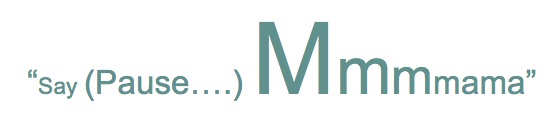
You can also give the whole instruction and then repeat the first sound that you want the child to imitate. In the following clip, watch as the teacher uses these strategies to work through problems with echolalia. The teacher is working on teaching expressive labels (that is, teaching the child to say the names of objects) and using verbal imitation to prompt the correct response.
Here is another example of how to work through problems with echolalia. In this video clip, the same teacher is working on teaching the child to take turns talking about pictures in a hand-made book. The book was made especially for this purpose. There is only one picture on each page and no pictures on the backs of the pages. This was done to minimize confusion and distraction. Still, watch how challenging it can be to teach a child with significant echolalia what he should and should not imitate. Notice how quickly she has to prompt him before he repeats whatever she says. The child is working hard too, and he is rewarded for his efforts with a cool magnet toy!
Find Reinforcers with Labels that Begin with Sounds Your Child can Imitate
Once your child can produce at least a few sounds, try to find rewards that start with some of those sounds. Then your child can learn to request those reinforcers using sounds or words. For example, if your child likes when you blow bubbles, you can hold the bubble wand up to your lips and prompt the child to make the “ba” or “bubba” sound, or to say the word bubbles if he is able. Wait for him to make the sound before you blow the bubbles for him. If he points to the bubbles or the wand, that’s great. You can even blow a quick line of bubbles for him. But, be ready to ask for the “Ba” sound, or an approximation of the word “bubbles,” for the next line of bubbles you blow for him. This should help your child to get the idea of using his sounds and words to communicate. If your child is capable of imitating more than a one-word request, by all means encourage him to do so!
You can use vocal/verbal imitation to prompt your child to ask for almost anything he enjoys. For example, you could ask for the “ba” sound for Book, Bunny, Bear (as in Teddy bear), Baby (as in baby doll), and Banana (though N works for this too; as in “nana”). Or, you could ask for the “Mmmm” sound for a sip of Milk, a photo of Mommy, or a mini marshmallow. You can even ask for the “t” sound for a tickle. If your child is routinely making requests by pointing or using picture exchange and making eye contact with you, and if he is also able to reliably imitate sounds or words, try prompting him to add a sound or word when making requests. Then reinforce him by giving him what he asked you for!