

Troubleshooting and Schedule Training
Troubleshooting
Potty Chairs Can Help if Your Child Is Afraid To Sit on the Toilet
Some children are afraid to sit on the toilet. This can add a challenge to toilet training. Some families use special children’s “potty-chairs” or “potty seat inserts.” There are many training chairs on the market.
If you train your child using a potty-chair, there will be some extra clean-up work. You’ll still need to move her to a regular toilet sooner or later. Some potty-chairs come with a removable seat that can be used on the regular toilet. Once your child is comfortable sitting on the potty-chair, you can use the same seat when moving her to the regular toilet. This will help your child overcome any fear of the toilet. Sometimes just using a toilet seat insert and a stool for her feet can help a child become more comfortable.
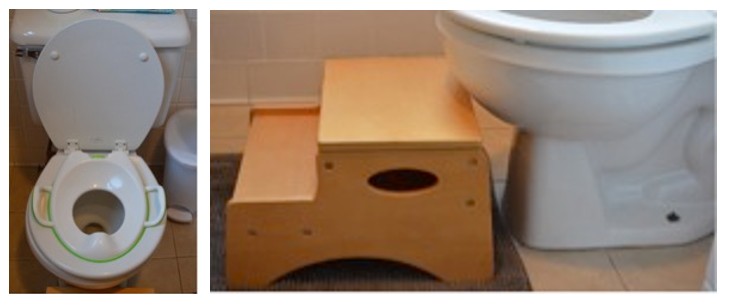
You can find toilet seat inserts in many colors. Some of them also have an attachment for boys that helps prevent urine from squirting over the seat and onto the floor.
Reward Sitting on the Toilet Using a Step-by-Step Approach
Sometimes, it can be hard to get a child to sit on the toilet. It can be even harder to get a child to release any urine into the toilet. In this case, it can be helpful to reward children for just touching the toilet at first. Bit by bit, you can require more and more from your child in order to earn the same reward. Do this until she is willing and able to sit on the toilet without becoming upset. This kind of step-by-step approach is sometimes called “shaping.” Here’s an example of the steps you could take:
|
Use any reward that you think your child would really like a lot. Remember that it may take weeks for a child to complete all of these steps, especially if your child is very fearful. It’s best not to push.. It’s better just to offer a favorite reward for practicing each step. Begin with a step that is easy for your child. Move slowly from one step to the next. Do this by giving a smaller reward, or even just praise, for a step that she can do. And give her a bigger reward for the new step.
Once your child has practiced the new step a few times, offer the smaller reward for that step and give the bigger reward for the next step. For example, if you are using M&M candies as a reward, you might offer 2 M&M’s for an easier step and 5 M&M’s for the new step.
You will need to use your judgement. If your child seems ‘stuck’ and is reluctant to try the next step, you can offer the reward only for the next step. But it’s important not to push too hard. If your child seems scared, just reassure her. Tell her it can wait until she is ready.
Schedule Training
Some children will do well at first, but will have difficulty staying dry with the longer time. For example, many children can remain dry and urinate in the toilet when you bring them every hour. But if you try to go to 65 or 70 minutes, they have accidents. For other children the time between sittings will be even shorter. If this happens, try keeping her at the time where she is successful for at least a week. During that time, she can practice urinating on the toilet and get lots of reinforcement for it. And be sure that your child has no more than one accident per week, before increasing the interval by only 5 minutes each time.
If you do this for several weeks and find that you cannot pass much beyond a certain point, it’s fine just to stop there for a while, prompting your child to request the toilet on a set schedule. We call this “schedule training”.
Bringing your child to the soilet on a set schedule can be a functional and workable solution to the problem of being stuck between expensive disposable diapers and endless laundry.
For children who have difficulty staying dry for longer times, schedule training can work. And you can avoid lots of expensive throw-away diapers or lots of laundry. Just keep your child in cotton underpants and use a timer for trips to the bathroom on a schedule.
If your child is doing well and remaining dry most days on a set schedule, try to increase the time very gradually as discussed above. If you are able to reach a two-hour schedule, you should try to move on to Phase 2 of the urine training program (in the next section) especially if she is still very young. However, if you had to work very hard to get to the two-hour schedule, and your child begins to have accidents when you try Phase 2, go back to schedule training for a while. If your child is showing signs of progress, terrific! But if you see that she is having accidents after about three weeks, go back to your schedule for a while. You can always try Phase 2 again at a later date. Teaching a child to initiate using the toilet is not necessary for staying dry. But it does help your child’s independence. And it helps to limit the accidents when adults forget to bring her to the toilet.
Using Fewer and Fewer Treats as Rewards for Using the Toilet on a Set Schedule
For some children, schedule training can be a good long-term solution for toilet training. If this is the case with your child, begin to reduce amount and frequency of reinforcement gradually. Pair your praise, tickles, hugs, etc., with food treats. Then gradually using fewer of the food treats to only once for every two or three successful trips to the toilet.
While schedule training can be a good long-term solution to challenges with toilet training, you should gradually reduce the amount and frequency of food treats for urinating on the toilet.
For example, say your child makes an average of 12 trips to the toilet per day. And say she usually pees on the toilet in 9 or 10 of those scheduled sittings. Praise your child every time she pees in the toilet. But offer her a food treat only 3 or 4 times a day. Over weeks, reduce that number more so that you are giving treats for success only once or twice a day.
Don’t reduce the food treats in any kind of predictable pattern. For example, don’t reward every other successful trip to the toilet or every third one. This could teach your child to make a good effort only every other or every third time you bring her to the bathroom. Vary the kind of reward you offer (praise plus food vs. only praise) in no set pattern. This way, your child won’t know when the food treats will be offered.
Encourage your Child to Empty Her Bladder Completely While Sitting on the Toilet
Pay attention to how much urine your child produces on the toilet. Sometimes a child will produce a small amount of urine and then stop before she has emptied her bladder. This results in accidents. You can usually tell if this is happening by listening carefully while the child is urinating. If you hear a small squirt of urine that ends suddenly, or if she produces only a very small amount, she probably has not emptied her bladder. In this case, encourage her to keep going. Let her know that she needs to finish before she gets the special treat for peeing on the toilet. What you want is to hear a strong urine stream that slows down to a trickle.