

The ABC’s Of Behavioral Teaching
In this section, we’ll talk about some general guidelines to help teach your child skills and behavior. Then we’ll explain the “ABC’s of Behavioral Teaching.” These are ideas and terms used in behavior analysis. These terms can help you understand books, articles, and your child’s therapy. You can skip the section on “The ABC’s of Behavioral Teaching” if you don’t want to learn this language.
Try Not to Pay Attention to Behavior You Do Not Like
When the child responds incorrectly or does not respond at all, just remain calm and neutral. This is not smiling and happy, but not unhappy either. Just pause for a few seconds and break eye contact with the child quickly. Then begin another learning trial again. This time, prompt her right away to do the correct thing, and reward her quickly after she has finished her prompted response.
When the child responds incorrectly or does not respond at all, just remain calm and neutral. Pause for a few seconds, breaking eye contact with the child briefly, and then begin another learning trial. Prompt right away and reinforce the prompted response.
In the following clip, the teacher shows the child how to copy her actions. She taps a spoon on the table and asks the child to do the same. The teacher stays neutral and does not reinforce the child’s silly behavior of banging the spoons together. She stops and starts again, guiding him quietly. Next, the teacher asks the child to put a block into a cup. The child throws the block at the cup, trying to knock it over. The teacher stays calm and neutral, asks the child to try again, and holds the cup still. When the child puts the block into the cup correctly, the teacher praises him and blows a bubble for him to pop.
By not giving attention to the silly behavior, the teacher avoids reinforcing it. Remember, attention can reinforce behavior, even if it’s negative attention. By prompting on the next trials, she gives him chances to get positive attention and bubbles as reinforcers for following instructions and imitating her actions.
Do Not Reinforce Guessing or Unclear Responses
It’s important to reinforce only very purposeful and clear responses. For example, say you want to work on teaching your child some new words. You place a bowl, a shoe and car on the table in front of your child and you say, “touch shoe.”
Attention can be a very powerful reinforcer; even negative attention! For this reason, try NOT to react strongly or talk about your child’s inappropriate behavior during your learning sessions.
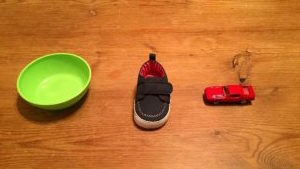
If she touches the bowl and quickly touches the shoe, try not to reinforce that response. Otherwise, she may get confused and not know which of the items she touched was the shoe. If this happens, pause quietly for a few seconds, then repeat the instruction and guide her to give a clear and correct response. Then reinforce the prompted trial. Avoid reinforcing guessing. Instead, guide a clear response and gradually reduce guidance over time. This way, you teach her to understand the word “shoe” without making many mistakes along the way.
Pause for a Few Seconds Between Teaching Trials
You might have noticed that there is a 3 to 5 second pause between the first and second trial, while the child is finishing his cookie. For most children, a 3 to 5 second pause between trials is about right. You want to give the child enough time to enjoy her reinforcer if she got one and also to be clear that the next trial is a new and different one. However, you don’t want the pause to be so long that you lose the flow. Try and get a sense of how quickly your child is thinking and responding. Each child will have her own best pace, so try to find the right pace, in between too fast where she gets frustrated and confused, and too slow, where she gets bored and stops paying attention to you.
Knowing When to Stop Trying to Teach a New Skill
Sometimes a child will have a lot of difficulty in learning a particular skill that you’re trying to teach. If you have been trying to teach a certain skill several times a day for a couple of weeks, using plenty of prompts and good rewards, and the child still doesn’t seem to be able to learn it, let it go for a while. Work on something else, and come back to it at a later time. If you keep trying to teach something that a child is just not ready to learn, you will both get very frustrated.
If you want a more detailed plan of what a learning session could look like, click here!
What Are the ABC’s of Behavioral Teaching?
You might have heard professionals talking about “discrete trials,” or “antecedents.” If you want to understand more about these terms (the ABC’s of behavioral teaching) click here!