

Stuffing
So far we’ve been talking mostly about problems related to picky eating. Now we’re going to address “stuffing.” Stuffing is another problem behavior related to eating. Stuffing is less common than pickiness but still occurs often in young children. Some children will stuff their mouths full of food, instead of taking in amounts they can safely chew and swallow. This behavior can become a habit that is rude, and more importantly, a choking hazard.
If this is a problem for your child, probably the easiest way to address it is to teach, or reteach, your child to eat independently, taking small bites, one at a time, chewing each bite completely and swallowing it, before putting another bite into his mouth. Let’s review this for a few different types of food, eaten with and without utensils.
When Your Child Is Able To Use Utensils
If your child is already using utensils to eat, you can begin by cutting your child’s food into small pieces and putting only one or two pieces on the plate at a time. Ideally, you should place them at opposite sides of the plate at first, so that your child cannot quickly spear them both with his fork. Prompt your child to spear one of the pieces of food, and block him if he tries to spear the second piece of food. After he puts the first piece into his mouth, prompt him to place the fork down on the plate, and praise him for chewing his food well. You may need to place your hand gently over your child’s hand to keep him from picking up the fork again and spearing a second piece of food.
For some children it can be helpful to designate a number of “chews” to make before swallowing, though for most children this will not be necessary. If you think this will be helpful, just pick a number that makes sense for the size and type of the piece of food he is eating. For example, if your child is eating waffles cut into very small pieces, you might say, “Chew 6 times. Let’s count! One, two, three, four, five, six! Great job chewing, now swallow.” Once your child has chewed and swallowed the first bite of food, prompt him to spear the second bite of food. And then repeat with two more pieces of food and so on.
If you have placed your hand over your child’s hand as a prompt to prevent him from taking a second bite too soon, you will need to fade your prompt. For example, you might need only to touch his arm or just lift your hand. Use whatever prompt you need to use to be sure that stuffing does not occur and that after he swallows the first bite of food, he then spears the second piece and takes the bite. Remember, as always, gradually fade your prompts over time, by making them more and more subtle until you are able to eliminate them altogether.
Once you no longer need to prompt your child to eat two bites, one at a time, gradually increase the number of pieces of food that you put on the plate at the same time. Over time, you can also place the pieces closer together.
If Your Child Is Not Yet Able To Use Utensils
The example we have given you involves using a fork, but you can do the exact same thing with finger foods except that instead of placing the fork on the plate in between bites you should put a napkin in your child’s lap and have him place both hands on his napkin while chewing. It is important that you teach the child to do something that helps him to control the speed of his eating. You can’t grab lots of pieces of food with a hand that is in your lap. In general, it is much easier to teach the child to do something else with his hands than just to teach him not to grab. We call this a replacement behavior. You’re teaching him to do something with his hands that replaces the grabbing and stuffing behavior. It’s much easier to stop doing something with your hands if you start doing something else with them.
In general, it is much easier to teach the child to do something else with his hands than just to teach him not to grab.
Now, you might be wondering, “If I’m teaching a new behavior, then what is the reinforcer?” If you think about it, you will see that each bite of food is the reinforcer for having chewed and swallowed the one before with hands in lap or utensil on the plate or in (or next to) the bowl.
In some ways, eating with a spoon is easiest of all because the size of the bite is limited by how much will stay on the spoon and you can’t add more until you have cleared the spoon. Therefore, you don’t need to put such a small amount of the food into the bowl. Just by having your child place his spoon into his bowl while he is chewing, you will be helping him not to stuff.
Physical Problems With Chewing and/or Swallowing
One other thing that’s not very common, but does sometimes happen, is that a child might seem to you to have difficulty coordinating the actual physical movements of chewing and swallowing. If you think this might be the case with your child, you need to consult your child’s doctor about getting professional help.
Teaching Children To Use Utensils
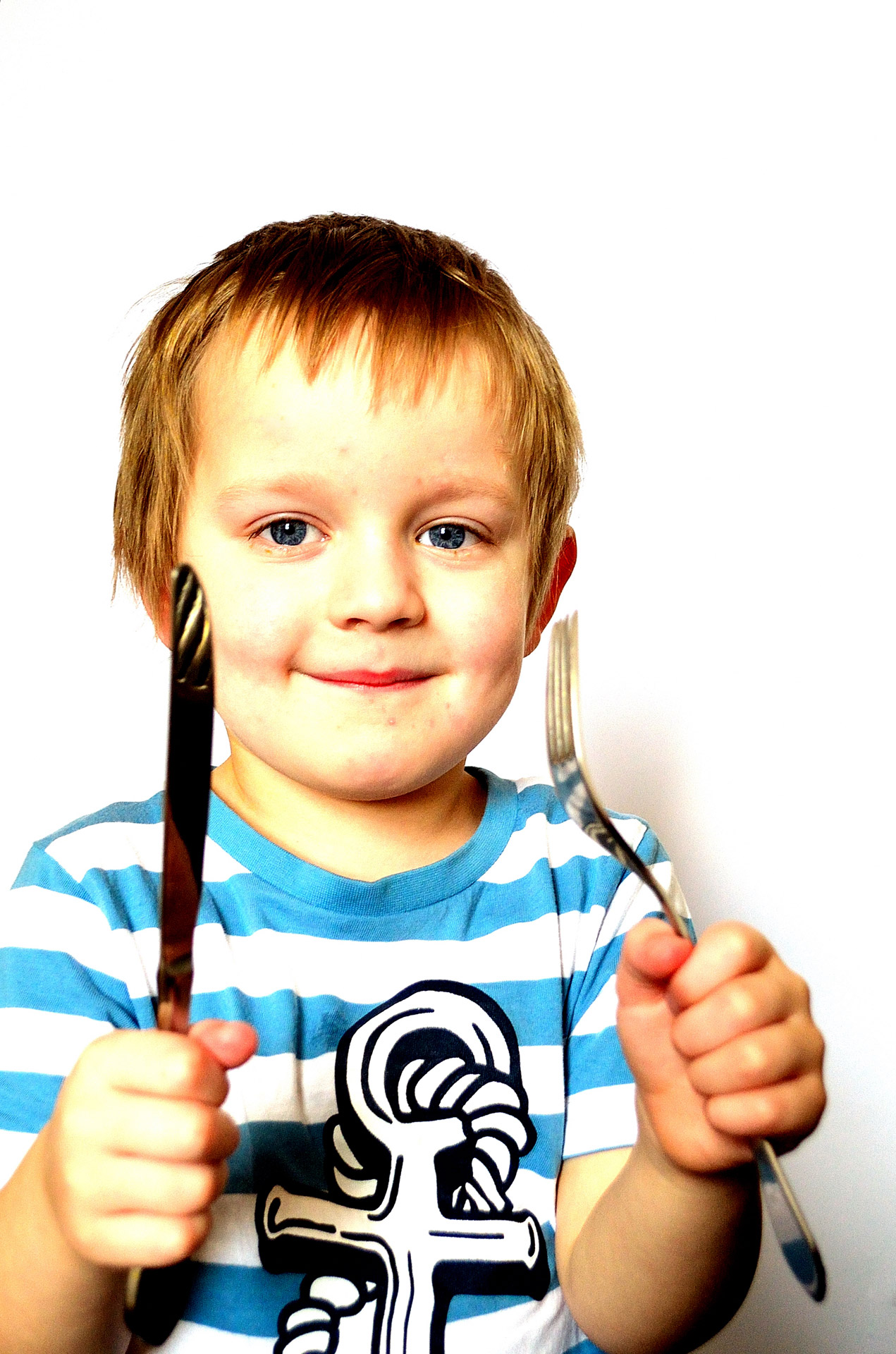
The last thing that we will address in this module is how to teach children to use utensils. Fortunately, this is pretty straightforward and most children are able to learn to use utensils quite easily. Just as you do when teaching any other skill, you should prompt the behavior you want and then reinforce it.
Let’s start with a fork, because a fork is generally easier to use than a spoon. Once you have speared the food with the fork, keeping the food on your fork as you bring the fork to your mouth is typically not much of a problem. The food can more easily slide off of the spoon so it may require a little more practice for your child to keep the food on the spoon as he brings it to his mouth.
Choose a food that your child enjoys that is easy to spear with a fork and easy to chew. Waffles and French toast, cut into strips and then small squares or rectangles, are a good option, provided, of course, that your child likes them. It’s better to prompt your child to pick up the fork from the table or plate himself, rather than you putting it into his hand, because in order to become independent with this skill, he will have to learn how to pick it up before using it. Simply use your own hand to guide your child’s hand to the fork and help him to pick it up from the table and spear the piece of food. Make sure he’s using it to spear food and don’t leave him alone with the fork!
Using A Spoon
If your child is now enjoying a few of the new foods you have introduced, try offering him those new foods in different places.
When teaching a child to use a spoon, ice cream, pudding, yogurt, or apple sauce tend to be a little easier than soup or cereal. Also, those are foods that are often highly preferred. If your child likes the food, that should motivate him to make the extra effort necessary to keep the food on the spoon all the way into his mouth! Teach the skill of using the spoon the same way you did for the fork, doing hand-over-hand prompting if necessary and fading your help so your child is doing it independently. Just be prepared to offer a little more help for a little longer.