Start As Early As You Can
Increasing social interactions and eye contact, and helping the child learn to enjoy adult company, can and should be done throughout childhood. However, this is especially important when your child is very young. This is because your child is just setting off on his development.
Imagine you’re the captain of a ship leaving New York for Europe, and you’re heading slightly too far south. You wouldn’t wait until you are close to the shores of Europe to make a change. If you did that, you would be very far off course by the end of the journey. But if you make the course change near the beginning of your trip, you will make a big difference in where you wind up.
Children respond to the activities we’ve been talking about in different ways. Some of this depends on the biology of their brains, which we don’t yet know how to change. Because of this, some children are able to learn more quickly or make bigger changes than others. Every child is unique and different. But all children are likely to learn best when intervention starts early in life. So, it’s good to put in the time and energy as soon as possible.
The most important things to work on are having the child interact with you, pay attention to you, make eye contact with you, and enjoy being with you as much as possible. And it is very important to begin working on these and other skills, as early as you can.
Create Happy Feelings
Another very important thing to work on is to create happy feelings in your child. Many toddlers with early signs of autism don’t show a lot of emotion. They don’t often seem happy and sometimes their emotions seem flat. However, this is not always the case. For children who don’t show a lot of happy emotion, you want to create positive emotion whenever you can. Do things that make them smile or laugh. You want your child to connect these happy feelings to being with you and other important people in his life. Watch how the adults in the next two videos create happy feelings while interacting with the child.
Children with early signs of autism sometimes have a hard time understanding or talking about their feelings. So, we also need to work on helping them to better understand emotions. You can do this by imitating their facial expressions and labeling their emotions.
For example, if your child is smiling and showing you that he is happy, give him a big smile back. Say the word “happy” or “we are happy.” Or, if your child is crying, look at him with a sad face and label his emotion also using his name. You could say, “Oh no, Davie is sad,” using a sad tone of voice. There are also many books written for children to help them learn about emotions. Be sure to show your child the different facial expressions. Also, put lots of emotion in your voice as you read to him, as the mom does in the next video..
Simple Communication
The next thing we are going to talk about is helping your child develop simple communication skills. These include requesting to end an activity, requesting to continue an activity, requesting a toy or snack, and making a choice between two things. These are all important skills that can be taught during everyday activities.
When children don’t have simple words or gestures to request the things they want, they tend to just whine or cry. It’s important for children to learn that there are easy and effective ways to ask for the things they want. They may also need to be taught how to gain an adult’s attention.
This is very important for children who have not learned to talk. It’s also important for those who do not understand a lot of words. They can still learn to communicate very simple messages nonverbally.
They can be taught to ask for things using eye contact and pointing. They can learn that shaking the head side-to-side means no, and nodding means yes. They can also learn that smiling shows pleasure and frowning can show others that they don’t like something. And many children can learn to use simple sign language.
Watch how this teacher models the sign and then prompts the little boy to do the same before taking him out of the highchair.
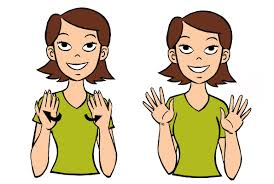
Another way to make the sign for “all done” begins with bending the arms upward at the elbows with the palms toward the chest. Then turn them outward as shown in the diagram. You can use either sign. The one in the video clip may be easier to prompt and easier for your child to imitate. The picture below comes from babysignlanguage.com. This website has very clear illustrations of many useful signs.