

Receptive Shapes
When teaching your child about shapes, follow the same approach as you did with words for objects and colors. Start by putting three shape cards or cut-out shapes on the table. To avoid confusion with colors, you can use all black shapes at first. Here are some examples of materials you can use:
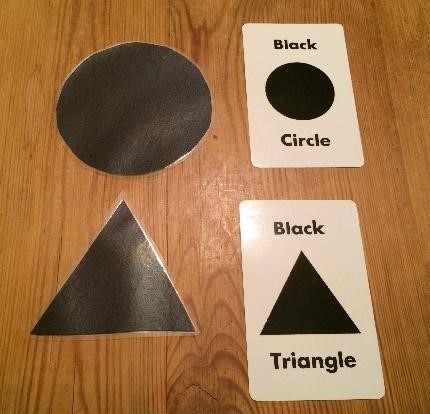
For instance, if you put a square, a circle, and a triangle in front of your child, label one of the shapes, such as “circle,” and prompt him to touch the circle.
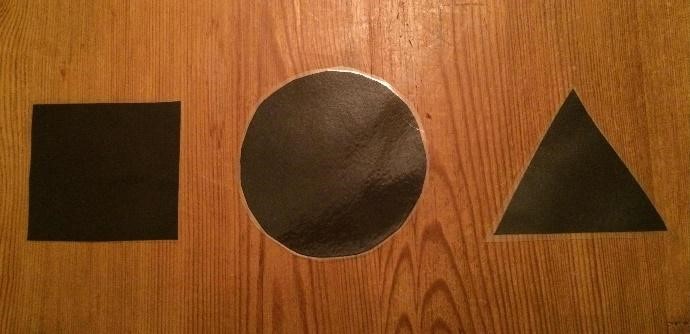
Remember to change the position of the shape cards frequently and present the trials in a random order, without a pattern. And, of course, reward your child with praise and whatever else you think he might like.
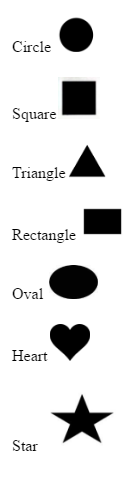
As usual, start with a set of three shapes. Once they are learned, add one new shape at a time. Always present the new shape in a random order, mixed in with two of the shapes the child has already learned. This is the same approach we discussed for objects and colors. We suggest beginning with circle, square, and triangle. Then you can add rectangle, followed by oval, heart, and star in any order you prefer.
|
As your child learns the shape words, remember to add the mastered shape words to your list of words he understands.
Working on Generalization of Shape Words & Color-Shape Combinations
To expand your child’s understanding of shape names to other things in his environment, you can point out various shapes in books and puzzles. You can also use this same teaching program with shapes of different sizes and colors. If your child has learned shape words and knows color words, see if he can identify specific color-shape combinations when you point them out. For example, lay out a blue square, a red triangle, and a yellow circle, and ask your child to find the yellow circle.

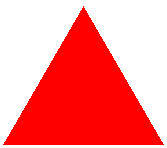
If your child does well with this level of difficulty, you can make it a bit harder. Use color-shape combinations that vary in only one attribute. For instance, lay out a blue square, a red triangle, and a red square, and ask, “Where is the red square?”
Since there is another shape that is red (the triangle) and also another square of a different color (blue), the child will have to listen carefully in order to respond correctly.
You can also start teaching the concepts of big and little by asking your child to find the big versus the little shape.


Of course, if your child is very good at learning shape names, you can teach other shapes too. However, for young children especially, it’s more important for them to spend time learning other important words. For example, the names of important people in their lives or words related to actions. We’ll discuss these two teaching programs next.