

Receptive Colors
Let’s start with colors. If your child has learned to match colors and has practiced color matching, he should be ready to start learning the names of the colors. In any case, make sure that your child can match the colors correctly, in at least 8 out of every 10 trials. If he cannot do this, then you will need to teach (or re-teach) color matching. Do this just as you have learned to teach the matching of objects. But with colors, do not include objects from other categories. Just use plain color cards for this teaching program. Once your child can match the primary colors correctly in at least 8 out of every 10 trials, he is ready to learn the names of these colors. He will have had a chance to hear the names of the colors while learning to match them. This should give him a good head-start!
Begin by putting three cards or pieces of colored paper on the table in front of your child. The basic colors are red, blue, green, yellow, and orange. Begin with any three colors and add the rest one by one. Once those are learned, introduce black, white, brown, pink, purple, and gray. Add them one at a time, in any order you want. You can also add any other colors you like. But this time, instead of using pictures, you will use solid color cards like these:



As with the other programs we discussed, it’s best to start by using just the name of the color as the instruction. If you place red, blue, and yellow cards in front of your child, simply say one of the colors, like “red,” and guide his hand to touch or point to the red card. If you think your child will understand, you can say “Touch red” or “Show me red.” However, it’s usually better to start with simple instructions and you can give longer ones with more words later if needed. And, of course, remember to praise your child and maybe give him a small treat if he would like that.
|
Remember to change the position of the color-cards frequently (otherwise, he might think that “red” means the one on the left) and remember to present the trials in a random order. For example:
Instructions Positions of Color Cards
“Blue”
“Red”
“Red”
“Yellow”
“Yellow”
“Blue”
Notice how the color cards are in different places each time, and the order of the trials is not predictable. For instance, you wouldn’t want to use a predictable order like red, yellow, blue, red, yellow, blue or red, blue, red, blue, red, blue. Using an unpredictable (random) order requires the child to pay close attention to pick the color you have named.
Test to See if Your Child Already Knows Some Color Words
Just like with understanding objects and animals, start with a set of three colors and see if your child already knows any of them. If you think your child might know one or more colors, begin with the ones he knows along with one or two new ones. It will give him a good head start!
When to Add a New Color
Once your child has learned the first set of three colors, add a fourth color, and so on. You should have three choices on the table for each trial. So on each trial, use two of the colors he already knows along with the new one. For example, if your child has learned red, blue, and yellow, you can add green next. Lay out the green card with blue and red for a few trials, and then switch it up by using the yellow card instead of either the blue or the red one. Keep going like this so that your child practices the colors he already knows while also learning the new color, in this case, “green.”
Add Color Words to the List of Words Your Child has Learned
Remember to add the color words your child learns to the list of words he understands. For instance, a child who has learned three colors along with about 20 other everyday words might have a word list like this:
| Food/Drink | Animals | Clothing | Vehicles | Furniture | Miscellaneous | Colors |
| Apple | Dog | Sock | Car | Table | Cup | Red |
| Cheerios | Cat | Shirt | Truck | Chair | Spoon | Blue |
| Cookie | Shoe(s) | Airplane | Bed | Puzzle | Yellow | |
| Bread | Pants | Train | Toothbrush | Green | ||
| Yogurt |
Teaching Your Child to Sort Different Shades of the Same Color
Once your child has learned five or six colors, you can expand the idea of colors by having him sort small pieces of paper with different shades of the same color onto paper plates or into small bowls. Paint stores usually have many paint chips that you can bring home and cut up.
Here are some shades of blue, red, and yellow that we found at a paint store:
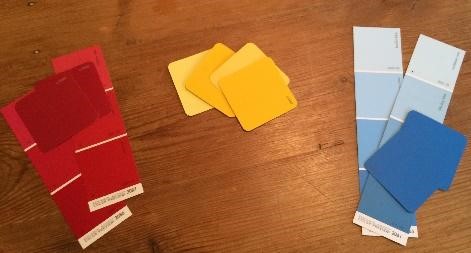
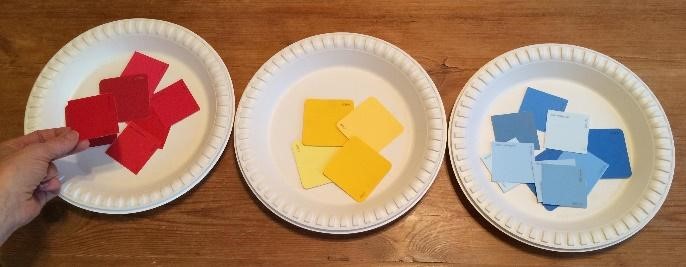
The goal is to teach your child to match all the shades of red with each other, all the shades of blue with each other, and so on. You can run this teaching program like you ran the non-identical matching program. Place one of the color cards your child has learned in one of three plates or bowls. You can add an extra shade of each color along with the original color card to help him understand what to do. As you hand him a new shade, name the color and guide him, if needed, to place it in the right container. Over time, reduce your guidance until your child can sort the different shades correctly. Avoid using colors that are not clearly one color or another.
In the following two clips the child is learning to sort colors. Notice that in the second clip, the teacher is working on teaching him to do this as an independent activity. She is standing behind him, ready to help if he needs it, and gives him only a little bit of praise. Eventually, she will remain completely quiet. She will offer him praise only after he has completed the whole sorting task.
Once your child becomes good at this, you can use these different shades along with the original color cards in the Receptive Colors program.