

Prompts and Prompt Fading
Now, suppose you want to teach your child to do something she has never done before. For example, let’s say you want to teach her to do a simple action such as raising her arms in the air. You might want to teach the child to raise her arms for several reasons; first, it’s a very simple thing to do, and often appears even in the first year of life when a child wants to be picked up. Second, since it’s a simple motion, you can use it as a basic tool to start teaching the child to imitate you.
Imitation is a very basic skill, that allows her to learn many other things. When children can imitate, you can show them how to do things they haven’t done before. Instead of using a physical prompt, you can just model the new behavior you want to teach. This can work for so many things, like brushing hair and teeth, pretending to feed a baby, or even drawing a circle.
If you model a skill and your child can copy or imitate what you have done, you will have an opportunity to reward her for having practiced the new skill. When you’re teaching a new skill, you want to give the child a chance to practice the skill so that you can reward her immediately after he does it.
But what if the child doesn’t know how to do it? Then, you will have to help her do the action you want her to do. In some of the clips you have seen so far, maybe you have noticed the teachers giving the children a little help to do things correctly, before rewarding them. This “help” or “hint” is called a prompt.
Watch the following clip in which a teacher is working with a very young girl. She wants to teach the child to copy her. The teacher says, “do this,” and lifts her own arms into the air. Then she gently lifts the child’s arms into the air. This kind of prompt is called a “physical prompt.”
When we use a physical prompt, we are physically helping the child to do the thing we want them to do. In the video clip you just watched, you may have noticed that as soon as the teacher could feel the child begin to lift her arms on her own, she reduced the amount of help she was giving. So, instead of prompting the child to put her arms straight into the air, as she did on the first and second practice trials, the teacher gently pulled the child’s arms upwards just until she began to feel the child push her arms up on her own. At that point the teacher let go, allowing the child to finish on her own.
This gradual giving less and less help is called prompt fading.When we fade our prompts, we must do it gradually so that the child is almost always successful. We call this “errorless learning” which means that we give the child enough help so that she doesn’t make many mistakes along the way. There are many great things about errorless learning. Best of all, it makes the learning process much more fun by taking away the frustration children feel when making a lot of mistakes as they learn.
Now, let’s watch that clip again one more time. This time, watch carefully to see how the prompts are faded. Also, as you watch, see if you can figure out which reward the teacher is using.
Did you notice that the first two times the teacher instructed the child to imitate, she prompted her within three seconds of giving the instruction? The teacher said, “Do this,” and then quickly helped the child to put her arms straight up in the air. On the third trial, she was able to give the child a little less help. Then on the fourth trial, the little girl did it all by herself! She didn’t do it perfectly, but she tried! It’s really important to praise and reward a good effort, even if the child is not completely successful. A good try is a very good thing! Remember, we are always working on building cooperation so we always want to reward a good try.
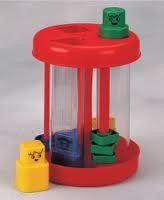
Did you happen to notice which reward followed the teacher’s praise? The teacher used a shape sorter toy that makes a little squeaking noise when the shapes slide down the tube. She praised the child enthusiastically. Then, she immediately handed her a piece of the shape sorter toy. By following her praise with a chance to play with a favorite toy, she is hoping that, over time, her praise will become a reward all by itself.
Now, back to prompting. There are many different ways to prompt a child to do what you want her to do. In the next clip, watch how another teacher uses a physical prompt to help teach a little boy to follow a new instruction, “walk around chair.” He already knows how to follow the instructions, “clap,” and “arms up.” The teacher does not need to give the child any help to follow those instructions. However, whenever she instructs him to “walk around [the] chair” she helps him enough to ensure his success.
As you watch the clip, notice how the teacher gives him a little less help over each trial. On the fifth trial, she offers him no help at all to see if he will do it by himself. She is testing to see if he has learned what “walk around” and what “chair” mean. When he’s not successful, she calmly directs him back to the chair. Then, the next few times that she gives him the new instruction, she prompts him again, giving him a little less help each time. By the eighth practice trial, she uses only a point to prompt him. On the ninth trial he follows the instruction, walking around his chair, all by himself!
So at this point, he has made a great start on learning what “walk around” and what “chair” mean and has put them together. Putting an action (or verb) and an object (or noun) together is a great skill when the child is learning to comprehend and speak simple language.
Did you also notice that even when the teacher prompted the child, she still praised him? Sometimes she even followed her praise with a small treat. She rewarded him just as if he had done it all by himself.
There are many different kinds of prompts. In the next clip, the same teacher is using a gesture prompt (pointing) to teach the little boy to match objects to pictures.
And in the next clip, she begins with full physical prompts to teach him to discriminate the words “on” and “under.” Then, after the first few trials, she switches to just pointing as a prompt.
As we discussed above, if a child can imitate, you can also model (show) the behavior you want them to do. In the following clip, a teacher is teaching a child to brush her hair, by modeling it.
And, if the child is able to imitate speech, you can use verbal imitation prompts too. In the following clip another teacher uses a “verbal imitation” prompt to teach a little boy to ask for bubbles. He is showing him how to request bubbles using words.
Now let’s go back to the idea of teaching a child to wave. In the following clip you will see a little girl who can imitate the words “bye-bye” but hasn’t yet learned to wave goodbye in response to another person waving goodbye to her. This would be a great thing to teach with two family members or teachers.
The two teachers trade places and take turns prompting the child. This way, the child has a chance to practice waving to both of them. Notice how the first teacher says, “Bye-bye” with enthusiasm. She is standing directly in front of the child. She speaks in a tone of voice that is loud enough to get the child’s attention. Since this child tends to avoid looking directly into other people’s eyes, the teacher waves her hand close to her own face at first. She does this to draw the child’s attention to her eyes.
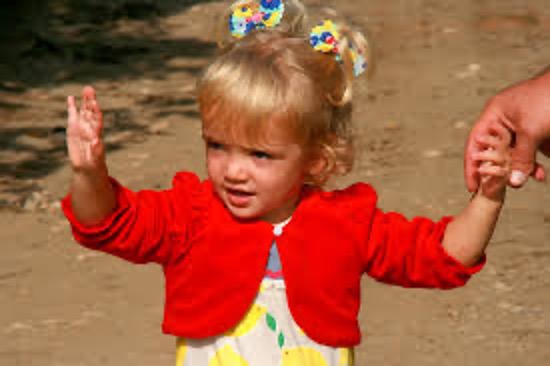
As soon as the first teacher says, “Bye-bye” and waves, the second teacher uses a physical prompt to help the child wave back. Watch how this teacher uses her own hand to physically help the child to wave. She also kneels behind the child and prompts her from behind. She does this so that her prompts will not interfere with the interaction between the child and the teacher who is waving to the child. Over the course of the six trials in this clip, the teachers gradually reduce the amount of help they give the child. At the end, they try using no prompts and the little girl does it all by herself.
Did you notice that the teachers tried to use the smallest prompts they could? It’s easy for children to come to depend on our prompts. If this happens, they will not learn to do the skill by themselves. For this reason, it is important to reward the child for more and more independence in doing the skill. But we do it slowly, reducing the amount of help we give only bit by bit. That way, the child makes very few errors while becoming more and more independent with the skill. This can require a lot of patience on your part! Learning new skills takes time. Don’t be in a hurry. It may take many sets of practice trials, day after day, for a child to learn a new skill.
It actually took many more than six practice trials of waving before this child really began to wave on her own. We have shown you only a few trials to give you the general idea of how to prompt and reinforce a behavior you want to teach. You will also need to fade your prompts slowly over time.
And, keep in mind, the clip you just saw was filmed on the very first day that this little girl’s teachers began teaching her to wave. They will probably need to work on this many more times, waving to her from further and further away. And they will probably need to use prompts to help her wave, at least at the beginning of their teaching sessions in the days or even weeks ahead.
We’ve said it before, but it’s very important: learning takes time…lots of time. Patience is key! Small gains are important!