for children with signs of autism or other developmental conditions
Prevention Of Problem Behavior
Functional Communication Training – Making Requests
Probably the single most important skill children can learn for the prevention of problem behavior is how to effectively communicate their wants and needs. A lot of problem behavior can be made unnecessary when parents are able to understand what their children want and need. You’re probably already trying to do this, and we’re going to give you some additional ways to help your child communicate what he wants without engaging in problem behavior.
This is one reason we spent so much of the first modules of this Training Program focusing on teaching children to make requests by using a point (pointing with a finger) paired with eye contact or using the Picture Exchange Communication System (PECS). Some children don’t develop speech when other children do, and have difficulty learning speech even with speech therapy, special learning sessions, or other kinds of therapies. For these children, learning to communicate requests by pointing, using PECS, or even just asking for help with a simple gesture or sign, is especially important.
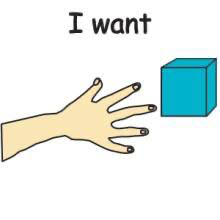
Even if you’ve decided not to use the PECS system, it might be helpful to have 5 or 6 pictures on one Velcro board that stand for: “I want…,” “help,” “no,” “all done,” and “break.” Here are pictures you can use:
I want:
Help:
No:
All done:
Break:
Even Children who CAN make Requests have Difficulty when they are Upset
However, here’s something important to remember: some children find it hard to make requests nicely once they become upset, even if they know how. This is especially true if the skill of making requests is new for the child and still requires considerable effort. For this reason, it’s a very good idea to prompt your child to make a request at the very first sign that he’s getting frustrated or upset. You can do this either by handing the child his PECS book or by asking, “What do you want?” or “What do you need?” If your child can speak a little, you can prompt by saying, “Say, I want…” and then leave it to him to fill in the blank.
If your child seems to be getting upset and you think you know what he wants, it’s better to prompt him to request it than to give it to him right away. This way, he will have more opportunities to use his requesting skills even when he is frustrated or upset. For example, if you think your child is upset because he wants a cookie from the kitchen cabinet, you can prompt him to request it by giving him a picture of the cookie and helping him hand it back to you or by helping him point to the cabinet. If your child has some speech, you can prompt him to say, “Cookie” or “Cookie please.” Over time, he will learn to use his requesting skills even when he is frustrated or upset.
Here’s another example. Suppose you are at the market and your child is sitting in the shopping cart. You walk down the cereal aisle and as you reach for the box of his favorite cereal he is smiling and becoming increasingly excited. As you grasp the box he reaches for it but begins to frown when you don’t offer him any. As you place it in the cart behind him, he watches you closely, he may reach for the box of cereal, but when he cannot reach it, he begins to frown and fuss. If you continue down the aisle he will likely become very sad and cry with some degree of desperation and frustration.
Freepik
His initial reach for the box would have been the best moment to stop and prompt your child to request some of the cereal by pointing to it. But even if you missed the first opportunity, once you realize that he really wants something, you can still prompt him to request it by helping him point to it. Then of course, reinforce the pointing by giving him a small amount of the food he has requested.
And this is a good idea even at times when you don’t really want him to have a snack; like while you’re still shopping in the store. It’s so important that he learn to ask for the things he wants, even when he is upset. Later, you can teach him how to wait for things or to understand a “first we do this /then we do that” kind of instruction. But until he understands those things, it is probably better to open up the box of cereal (or the bag of chips, or whatever it is he really wants) and offer him a few pieces, than to have him become upset and frustrated because he cannot communicate his requests effectively. Think of it as a great opportunity to work on requesting when upset, which is such an important skill.
Here’s another example. Say you are in the park with your child and he is in a stroller. He sees another child feeding bits of bread to the ducks in a small pond. He is very interested in the ducks and begins straining to get out of his stroller. Even though you know what he wants, and you could let him out of the stroller without having him ask to get out, it really is best to use this as a learning opportunity. You could do this in several ways. You could prompt him to point to the ducks and then look at you, or you could offer him his PECS book, if you’re using one, and direct him to select and hand you an appropriate picture or symbol, such as “Duck” or “Out.”
Or you could prompt him to use a gesture to communicate that he wants to be taken out of the stroller, such as holding his arms up to you while making eye contact.
Look for Opportunities to Teach Communication Skills in the Natural Environment
When you take advantage of natural opportunities for teaching that arise during everyday activities, the reinforcer is built in. For example, taking a child out of the stroller will be a natural and powerful reinforcer for his having requested it.
Make Special (PECS) Picture Book for Special Outings
And here’s another important thing to remember if you are teaching your child to communicate using PECS; when you bring your child someplace special, like the park, it’s very important to make pictures of the various things your child tends to enjoy in that special place. Preparing these pictures in advance and attaching them to the front of your child’s PECS book, is a way of giving your child the very words he will need to communicate what he wants most.
Teach Your Child to Ask for a Turn
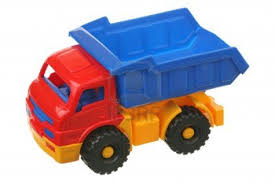
Here’s one more example. Say your child loves to play with little toy cars and trucks. He sees his brother or sister playing with one of his favorite toy trucks, runs over, and grabs the toy away. This is a teaching opportunity. Instead of scolding him as you might be tempted to do, gently, but firmly remove the toy from him. As you give it back to his brother, prompt the child who grabbed the toy to request the toy from his brother. He can point to the toy, or use a picture of a toy truck or a symbol that illustrates “my turn” which can be used with any toy. (See Module 4 for more detail on how to teach your child to take turns).
OR
clipart.library
Of course, this will require that the other child is willing to work with you and agree to share the toy when asked nicely. If so, you should be sure to praise the other child and make sure he has the toy returned to him as quickly as possible. One way to do this would be to wait until the child who is working on learning to communicate has had a few minutes to play with the toy, and then have the other child request a turn in the same way, for example, the picture of the toy if you are using pictures, or pointing to it and asking for a turn. Of course, you will also need to prompt your child to return the toy and then reward him for doing so.
If your child can already say a few words, it’s fine just to prompt him to ask for the toy using words. But here’s an advantage of using PECS: PECS teaches children to get the attention of their communication partner (see the Module 13 on PECS for details) before making requests and this will go a long way to helping a child be successful when he makes the effort to ask for things in an appropriate way.