

PECS Phase 1: Initiating Communication
Initiating Communication
Once you have picked at least two or three of the rewards you will use to teach Phase 1 of PECS, and have made at least one picture to go along with each of those rewards, it is time to begin teaching. When you start teaching PECS it will be much easier and better to work with a helper if possible. That way there will be one person in front of the child, and a second person behind him. Both people should be about an arm’s length away from the child. Perhaps you have a family friend or a family member, such as the child’s aunt or uncle or grandparent. Or maybe your child has an older sibling. Almost anyone can be taught to perform both roles. And it really is best to do this with two people at first, if at all possible.
The person in front will be the “communication partner”, or the person to whom the child will direct his request. The person behind the child will prompt him using physical guidance. In earlier sections, we discussed some different kinds of prompts or cues, including gentle physical prompting. We’ll call the person who stands behind the child and provides physical guidance, the “physical prompter”.
used with permission from PECSUSA.com
The communication partner should be holding one of the rewards you have chosen for your child. This should be something you are nearly sure he will reach for when he sees it.
Also, the picture of the reward you have selected should be placed easily within the child’s reach. While you do not need to begin this teaching program in any special place, it will be helpful, especially at first, to have the picture on a flat surface. For example, if the child is sitting on the floor you could place the picture on the floor in front of him. If the child is standing or sitting, you could place the picture on a low table or counter next to the child.
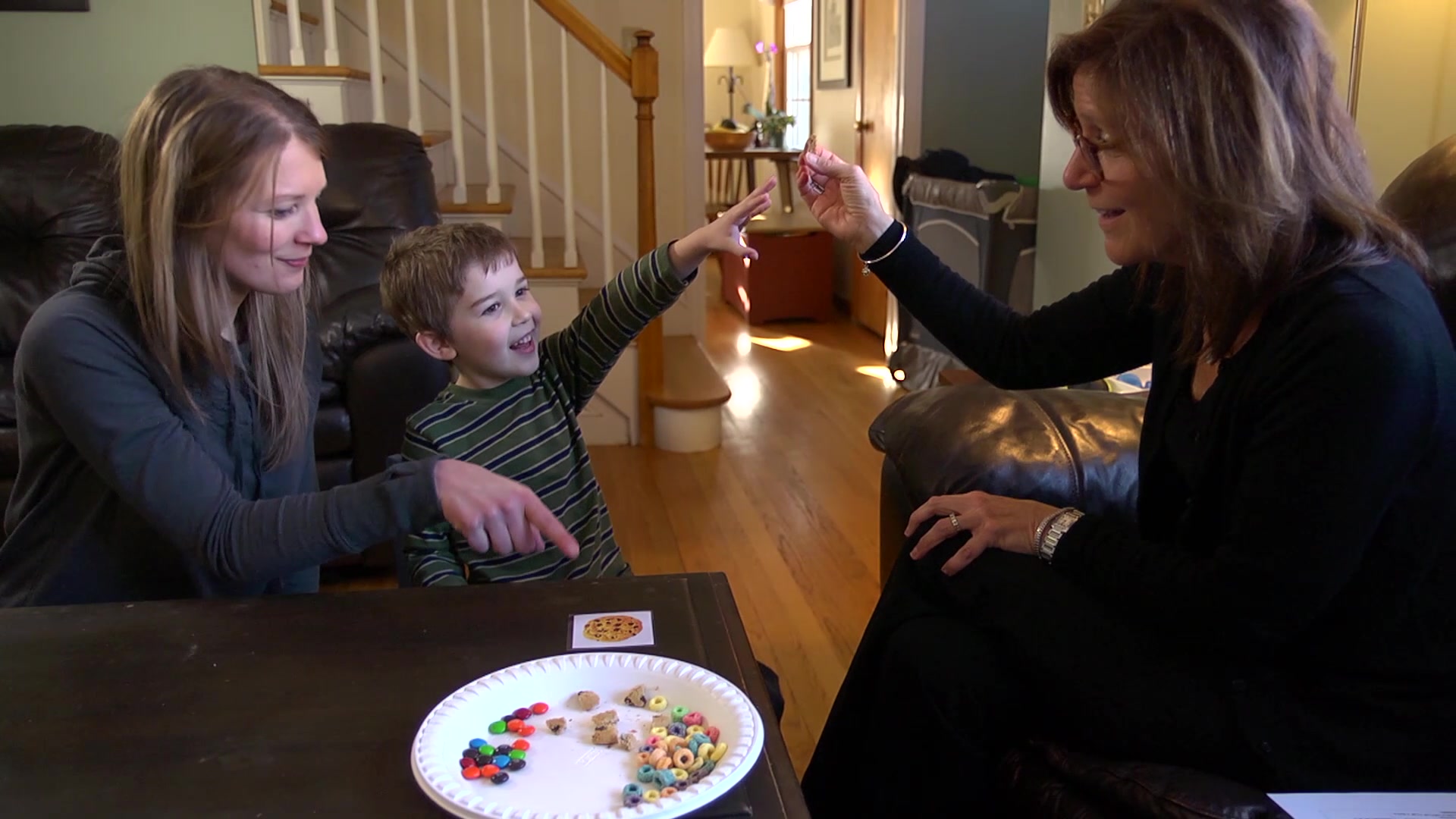
While it is important not to use ONLY food rewards, it is probably easier to use a food reward for at least the first few trials. This is because once a small piece of a treat has been eaten you don’t need to take anything away from the child to start the next learning trial. And, by giving the child only a small piece of a favorite treat, he will almost certainly be looking for more. Also, a small piece of a food treat is very easy to handle. Of course, if there are no food treats that are among your child’s most favorite things, then you should definitely begin with something else that is one of his favorite things!
When teaching a child to make requests using PECS, it is important for the child to be the one to initiate the request. Therefore, you hold the reward in your hand, directly in the front of the child, but you shouldn’t say anything. Don’t ask questions like “Do you want this?” or “What do you want?” Simply hold the item up, stay quiet, and when the child reaches for the item the very first time, hand it to him. This should reinforce him attempt to reach for it, making it more likely that he’ll continue to reach for it when he sees it again.
Once the child is finished with the reward, you should hold up another piece of the same treat. This time, the “physical prompter” (the person standing or sitting behind the child) should immediately prompt him to pick up the picture of the item and place it into your outstretched hand.
At first, your child will need a lot of help to pick up the picture, hand it to you and release it into your hand because he won’t know what he is supposed to do. The physical prompter should place his or her hand over your child’s hand and use hand-over-hand physical guidance to show your child what it is he needs to do and to help him to do it. It is very important to do so without talking, offering only physical guidance from behind. And over time, the physical prompter should fade the prompts, gradually giving the child less and less help until he can do it by himself.
Did you notice that the physical prompter didn’t interact with the child at all, except to offer physical prompting from behind? That’s because it is important to get the child to focus his attention on his communication partner.
Immediately after the picture exchange is completed, that is, as soon as the child hands you the picture, you should give the child the item he’s requested and while doing so you should label the item in a happy and enthusiastic tone voice. So, for example, if the child has handed you a picture of a cookie, you should hand the child a small piece of the cookie immediately while saying, “Cookie!”
Also, remember that after each trial, you must put the picture back to where your child will be able to reach it easily during the next trial. You should continue to practice, using the reward you chose, as long as your child remains interested in that reward. If you see him starting to lose interest, try using one of the other rewards on your list. To do this, simply remove the picture of the first reward, and replace it with the picture of the new reward and then continue in the same way, using the new reward. In the following clip, the teacher begins the lesson using bread and later changes to Cocoa Puff cereal when the child begins to seem less interested in the bread.
used with permission from Andy Bondy
Do you remember our discussion in an earlier section about fading the prompts? The idea is that you give no more help than the child really needs. As the child needs less help, you should fade the prompts, giving less help. Over time, the child should become more and more independent. In the case of teaching PECS, the physical prompter should fade his or him prompts, giving the child less and less help as he begins to do some, or all, of the exchange by himself. For example, you might find that once the child’s hand is directed to the picture, he picks it up by himself. Then once it’s in his hand all he needs is a very gentle push on the back of his arm, moving it gently forward. Or, you may find that he needs help for a while to pick up the picture but that once it’s in his hand, he completes the exchange all by himself. No matter what kind of help your child needs, the physical prompter should continue to provide it, giving less help only as your child needs less help to be successful. In the following two video clips, notice how the Physical Prompter gives less and less help as the child begins to do more and more on his own.
Once the prompts are faded and your child is reaching for the picture, picking it up and placing it into your hand without any help at all, try switching roles with your helper. Your helper plays the role  of the communication partner and you are the physical prompter. Don’t be surprised if your child needs help again at first when you switch roles. Just give him as much help as he needs. Fade your help as you see him begin to do parts of the picture exchange independently.
Over time, it will be important for your child to practice making requests using PECS with all of the people in his life. This will include family members and friends that he sees often. After all, you want him to be able to ask anyone in his life for the things that he wants.
Depending on how much your child wants the rewards you have, you should be able to practice PECS in sets of 10-20 learning trials at a time. If you do this several times a day, you may be able to practice Phase 1 without a helper within a day or two. How will you know that you don’t need the helper anymore? You don’t need the helper if the child reaches for the picture and puts it in your hand without a physical prompt.
As we have said before, all children learn different things at different rates. Just continue to give him as much help as he needs to be successful. Be sure to give him what he has asked you for as soon as he puts the picture in your hand and lets go. And don’t forget to always name the item as you hand it to him. A single word is best. For example, when he asks for bubbles, just say, “Bubbles!” as you hand him the bubbles. When he requests a cookie, just say, “Cookie” as you hand him the cookie. That way, he may learn what those words mean. Remember, the goal with PECS is to teach the child to ask for things using picture exchange. In the Let’s Talk module, we will discuss how to work on your child’s speech. But for now, we are working on teaching PECS.