

Using PECS In More Situations
As you plan learning sessions, it’s a good idea to start to think about your child’s day. More specifically, you should think about the situations in which your child is most likely to want things that he may not be able to get on his own. For example, in the bathtub he may have special bath toys that he likes to play with, like a cup to pour water with, or little plastic numbers or letters that stick to the bathtub or sink. In a sandbox, he may like to play with a pail and shovel or with cars and trucks. And, of course, children are most likely to think about food when they are in the kitchen. (Of course, when the child is in the bathtub, you will want to use just a plastic picture page, instead of the whole PECS book.) Don’t worry too much about getting a little water or sand on the PECS binder. After all, a well-used PECS binder is the best kind!
Try to practice PECS training in the actual places and during the actual activities where your child is most likely to want things. If he wants something enough, he may just begin to request it using PECS on his own. Just make sure that you have the right pictures for each activity. Also, remember that during Phase 2 of PECS training, you should continue to place only one picture at a time on the front cover of the binder. This should be a picture of whatever you are making available to your child at that moment. Later we will show you how to begin teaching your child to choose the right picture from two or more.
Beginning to Work on Eye Contact During PECS Training
Here’s another thing to think about: So far in our discussion of PECS, we have not talked about eye contact. While eye contact should not initially be required as part of the PECS request, now is good time to begin working on it during PECS training. Be sure your child is consistently able to walk to his binder, remove a picture, walk across the room to you, and hand it to you in order to request an item that you have. Then you can begin to wait for eye contact before you accept the picture into your hand. Whenever your child is looking at you as he approaches, be sure to smile at him, accept the exchange quickly, and immediately hand him the item while labeling it. However, if he is not looking at you when he approaches you, look at his eyes while holding your arm outstretched but curl your fingers in, like this.
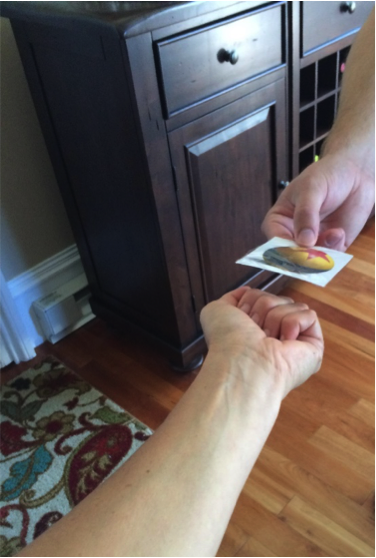
Wait a few seconds. he will probably be a little confused and may look at you to better understand what is happening. If so, the instant that he makes eye contact with you, give him a big smile, open your hand, take the picture, and give him the item he has requested, labeling the item as you do so. If he still does not make eye contact with you, try prompting eye contact by holding the item directly in front of your eyes. However, be sure not to frustrate your child during PECS training. If he doesn’t seem to know what you want him to do, just accept the exchange and give him the item before he becomes frustrated and upset. You don’t have to work on eye contact on every PECS trial either. Just be sure to look for opportunities to reward eye contact with a broad smile and an immediate response to his request. There will be plenty of opportunities to reinforce eye contact during PECS training and throughout many other parts of your child’s day as well.
Teaching the Child to Get Your Attention
Now we are ready to discuss the final step in Phase II: teaching your child how to get your attention. Ultimately, you want your child to be able to make requests using pictures spontaneously outside of the training sessions. To use PECS in real life, amidst the ongoing activity of a busy household, your child will need to be able to get the attention of a communication partner. You may be busy and not realize that he is about to make a request, so he has to learn to get your attention first.
Begin by pretending that you are not paying attention to him when he approaches you. For example, you could pretend to look at a book or magazine or to work on a puzzle when he is walking toward you. With the physical prompter following closely behind, see what he does to get your attention. He may try to grab your hand or your arm. If he does so, the physical prompter should gently help him to tap you on the arm. As soon as you feel the tap, immediately turn toward your child and extend your open hand. Accept the picture into your outstretched hand. Then immediately hand him the item he has requested while labeling it.
Over time, you can begin to make it more difficult for your child to gain your attention so that sometimes he has to tap you more than once before you respond to him. In fact, you want him to learn how to nag you!
Learning how to get another person’s attention is another very important communication skill. Once your child knows how to get your attention by tapping you while using PECS, you can practice this when you are working on pointing requests too. However, we don’t want you to work on this every time that your child makes a request because that will probably frustrate him. That also doesn’t really happen in the real world. There will be many times that you are already paying attention to your child and interacting with him when he decides to make a request. You will want him to learn that sometimes he needs to gain your attention and sometimes he doesn’t need to because you are already paying attention to him.