

Non-Identical Matching And Picture To Object Matching
Now let’s talk about teaching your child to match non-identical objects, that is, objects that are similar but not exactly the same. We’ll also talk about matching objects to pictures. Why are these important skills? Children need to understand that things can belong to the same category or serve the same function even though they don’t look exactly the same. For example, two cups that don’t look the same are still both cups and can be used in the same ways. Two shoes that don’t look the same are both shoes and both go on your feet. A rose and a daisy are both flowers. A cookie and an apple are both foods, both things you eat. This understanding is important for the development of thinking and reasoning skills, and for learning language.
Matching objects to pictures is important, too. Your child should learn that a picture looks like, and represents, a real object. If he understands this, it will be easier to teach him words using pictures. This can be much more efficient than using real objects or having to demonstrate each action. If he uses pictures to communicate (PECS) it will be easier if he can match pictures to objects.
Do New Teaching Programs In Between Those Your Child Can Do Well
Teaching these more advanced matching skills is very much like teaching a child to match identical objects. You can teach non-identical object matching and object-to-picture matching in any order. For example, in one learning session, you can review programs your child can already do, like imitation with and without objects, following simple instructions, and identical object matching and matching identical objects.
When introducing new teaching programs it is often a very good idea to sandwich a single new teaching program in between teaching programs that your child can do very well.
Then, you can also work on non-identical object matching or picture-to-object matching. When introducing new teaching programs, it’s a good idea to sandwich a new program between programs your child already does well. If your child can match two identical objects and imitate any action you make, continue practicing those skills often. These are your “maintenance” programs. This means that your child already learned them but still needs practice. You should do them at least two or three times a week until your child can use those skills on his own, in different settings and with different people. This way, you will make it more likely that he will not lose the skills that he has learned.
Too many new teaching programs in a row can be too much. So, it’s best to mix in new programs with those your child can already do well. This will help build his confidence. And when you teach new skills, be sure to give him lots of chances to practice with your help. As your child becomes familiar with the new programs, he’ll realize that you’ll always provide the support for his success. This will make the new programs less stressful for him.
A good order might be something like this:
- Imitation – With and Without Objects (Maintenance Program)
- Identical Object Matching (Maintenance Program)
- Non-identical Object Matching (New Program)
- Following Simple Instructions (Maintenance Program)
- Picture to Object Matching (New Program)
- Making Choices using a Point with Eye Contact (Maintenance Program)
We want your child to have success during learning sessions. That’s why it’s important to start and end with activities they already know. This helps create positive and happy moments!
Non-Identical Object Matching
Now, let’s talk about non-identical object matching. You can begin teaching this by using some of the objects you used for teaching matching identical objects. Look for objects that are similar but not exactly the same. Here are some suggestions. If you used shoes, mittens, blocks, and spoons for matching identical objects, you can find different shoes, mittens, blocks and spoons (like plastic or wooden ones instead of metal). Or you can use blocks of different sizes, shapes, or colors to start teaching non-identical object matching. Here are a few examples:

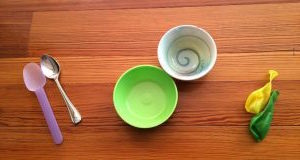
As before, place three objects on the table in front of your child and give him the matching object for one of them. For instance, you can give him one spoon while saying “spoon.” Prompt him to place the spoon in his hand beside the one on the table. Use a prompt that you are pretty sure will work. It can be a hand-over-hand prompt, where you help the child physically place one spoon next to the other. Or just pointing to or tapping the spoon on the table might be enough of a prompt. If you think your child knows the word “spoon,” you can say “Match” or “Match spoon” as the instruction, or even “Put with spoon.” The choice of instruction is up to you. Remember, if your child has limited language skills, using just the name of the object can help them become more familiar with the words. This may be useful when you work on learning the meaning of these words later on. And, of course, don’t forget to reward your child with praise, along with a little treat, or a tickle or bubbles, or something else that he likes.
- Place three objects on the table in front of your child.
- Hand him the (non-identical) match for one of the objects.
- Give a clear and simple instruction. For example, “Spoon” or “Match spoon”.
- Use a prompt you are pretty sure will work. You will use smaller prompts over time.
- Reinforce your child for making the match.
Remember, by following these steps, you can help your child learn and have fun at the same time!
As always, if your child seems to understand more language, you can change your instructions. For example, you can use more natural language and say things like “Find the other spoon” or “Match the spoons” or ask questions like “Where does this belong?” When praising your child, it’s a good idea to use words like “both” or “other.” For example, you can say, “Great! Those are both spoons!” or “Super job! You found the other spoon!”
Test at the Very Beginning to See If Your Child Can Already Do This
It’s okay to test at the very beginning, to see whether your child can match the new item right away. You would do this before you even start teaching this skill. Just give your child the item you want him to match and give a simple instruction, but do not prompt him. If your child responds correctly, that’s fantastic! Change the position of the items and try it again. If your child can do this correctly three times in a row without any help, you can assume he will be able to match that pair of items (for example, two different mittens). Then you can move on to the next non-identical pair (for example, two balloons) and see if he can do it without any help.
If he can already match a couple of non-identical object pairs, that’s great! It will be easier to start with one or two items that your child already knows, mixed in with one or two new ones. That should help him to learn the new one more quickly.
In the next video clip, the teacher is testing to see if the child can match two different mittens. She helps/prompts him to match the cars and the shoes, but she tests to see if he will match the mittens for the first time without help. At first, the child doesn’t place one mitten on top of the other as the teacher would like. But it’s clear that the child understands that the two mittens go together. The teacher helps the child place one mitten on top of the other. Then she tests two more times. The child responds correctly both times. This shows that the child can match two mittens. The teacher can then move on to teaching another item. She will also have the child practice this one in between the new ones they will learn.
Begin with Three Sets of Objects
Start with three sets of matching objects, like two cars, two spoons, or two blocks. Prompt your child only when he needs your help. Gradually reduce your prompts until he responds correctly with all three matches. Remember to present the trials in random order, so there’s no regular pattern. This way, your child won’t have any clues about which object you’ll present next.


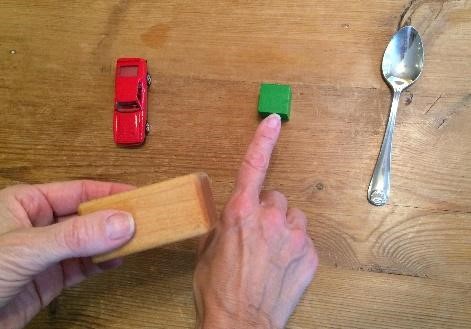
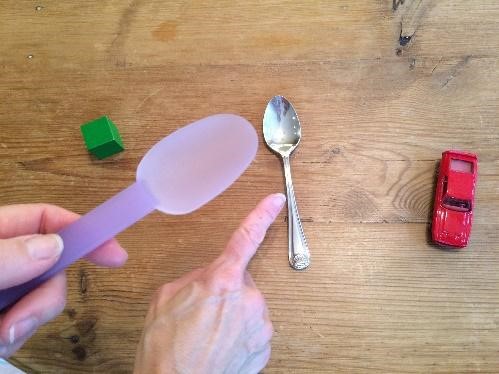
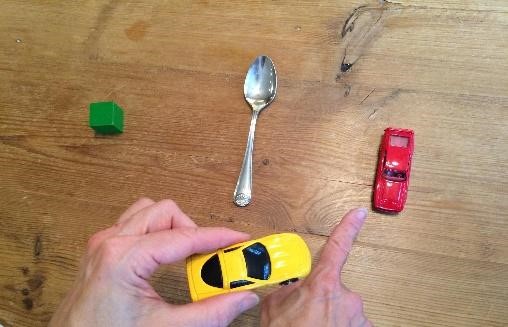
Keep Track of Your Child’s Progress
As we said before, it’s important to track how often your child needs help and how often he can do the task on his own. Before you introduce a new object or a different example of the same object, make sure your child can match the pairs you’ve already taught without help. You want him to become more independent over time, until he can do the task on his own in at least 8 out of 10 trials. Once he reaches that level, you can add a new type of object or a different example of an object you’ve already used. For example, if you started with two cars for non-identical matching, you could find a third type of car and have your child match it with one of the two cars you started with. Or you could introduce a new set of non-identical items, such as two different cups. Remember, even after your child masters the first three matches, he may need some prompting when you introduce a new pair of objects. That’s okay. Just gradually reduce your prompts until your child can match all the pairs without your help.
Remember to Present Your Trials in an Unpredictable Order
When you introduce a new object, try to include it in about 4 or 5 out of every 10 trials. Allow your child to practice matching the items he has already learned in the remaining 5 or 6 trials. For example, let’s say your child has learned to match spoons, blocks, and cars, and you’re introducing cups.
Here are some sample orders for a set of 10 trials, with ‘cups’ as the new target item:
| Sample Order 1 | Sample Order 2 | Sample Order 3 |
| Cups | Spoons | Cups |
| Blocks | Blocks | Cups |
| Cups | Blocks | Cups |
| Blocks | Cups | Blocks |
| Spoons | Spoons | Cups |
| Cups | Cups | Spoons |
| Cars | Cups | Blocks |
| Cups | Cars | Cars |
| Cups | Cups | Cars |
| Spoons | Cars | Cups |
These are only suggestions. You should always try to mix up the order, so that there is never any pattern that your child sees often enough to learn.
What to Do if Your Child Begins to Make Errors on Mastered Items
Make sure to practice each of the mastered items at least once every day. Watch out for any mistakes. If you notice that your child is starting to make mistakes on an item that you thought he had learned well, treat it as a new item. Present it about 4 or 5 times out of every 10 trials. Provide prompts as needed. Gradually reduce the prompts as you go, just as if you were teaching it for the first time. Eventually, he will relearn it.
Non-Identical Picture Matching
In addition to matching non-identical objects, you can also teach your child to match non-identical pictures. You can take pictures of your non-identical object pairs and have him match the two pictures. Or, you can find pictures of similar but non-identical objects and animals online and have him match those.

Even if you began with objects and your child did well with them, it’s also good to practice matching pairs of non-identical pictures. You should use the same steps we talked about for non-identical objects.
Picture to Object Matching
Picture to object matching can be taught in a similar way. But instead of using two objects, use pictures of objects matched to the actual objects. If you have a camera or a phone with a camera, you can take pictures of the objects your child has been learning to match. Then, your child can learn to match the pictures to the objects. If you don’t have a camera, but you have access to a computer and the Internet, try to find pictures that look like the objects your child is learning to match, even if they’re not exactly the same. You can also look for pictures in magazines or use flat puzzle pieces. Once you have a small group of object-picture pairs, you’re ready to begin. Here are some examples:

To start, place three objects on the table in front of your child. Give your child one of the pictures and say the name of the object, like you did for identical and non-identical object matching. The goal is for your child to place the picture you handed him on top of or next to the matching object. You can test if your child can match any of the object-picture pairs three times in a row, in different positions, without any help or teaching. If your child can do it, that’s great! It means he knows that object-picture pair. But if not, provide prompts as needed to make sure he responds correctly every time, slowly reducing the prompts over time.
- Place three objects on the table in front of your child.
- Hand him one of the matching pictures.
- Give a clear and simple instruction. For example, “Shoe” or “Match shoe”.
- Use a prompt you think will work. You will use smaller prompts over time.
- Reinforce your child for making the match.
In the next clip, you’ll see a child matching objects to pictures of those objects. Notice how the teacher places three paper plates on the table. She puts one of the objects on each plate. This helps make it clear where the child should place the matching picture. While not necessary, it can be helpful in the beginning.
You can start with the objects on the table and have your child place the pictures onto or next to the objects. Once he is successful with several sets of object-picture pairs, you can switch it up. Instead of placing the objects on the table, place the three pictures on the table and hand him one of the matching objects. He should put the object next to or on top of the picture.
It’s important that your child gets the idea of matching well enough to match the object-picture pairs no matter which one is on the table, and which one is in his hand.
If this is hard for your child, make it easier by using objects that are very different from one another. For example, if you’re using a real spoon along with a picture of a spoon as one of your object-picture pairs, make sure the other two object-picture pairs don’t look like a spoon or have a similar function. For example, using a block or a shoe would be better than a fork or a bowl.
Generalized Non-identical and Object to Picture Matching
You should continue working on non-identical matching and object to picture matching until your child fully understands them. Generalization is key. Generalization means your child can match brand new pairs of non-identical objects or object-picture pairs. If you show him about 10 new pairs of non-identical objects or object-picture pairs, and he can match them all on the very first try, then you don’t need to teach more pairs. But you should continue to practice these skills at least 2 or 3 times a week. And you should continue to practice with new things to match. You will want your child to maintain this new skill. As we talked about in Module 10, maintenance programs are teaching programs the child has learned and is now practicing so he doesn’t forget them. And keep adding some new pairs as you go along. This will help him to generalize matching skills.