

Setting Up Your Learning Place
Selecting a Learning Place
To get started, it’s a good idea to set aside a special “learning place” for your child. This will be a small space that your child will come to know means “it’s time for lessons.” The space you choose depends on your home. Most people do not have a space that they can set aside just for learning sessions. If this is true for you, you can help your child understand when it is time for learning by making a separate space with a line of some sort using tape, ribbon or string. Or, you could use a blanket, a curtain or a piece of furniture. Here are some examples, showing how part of a room has been temporarily sectioned off using tape or a blanket. Once the learning session is over, the tape or blanket can be removed, indicating to your child that the lesson is finished.
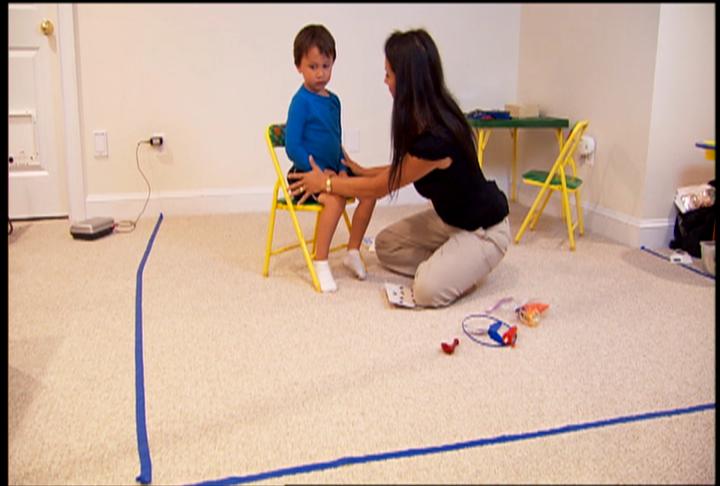
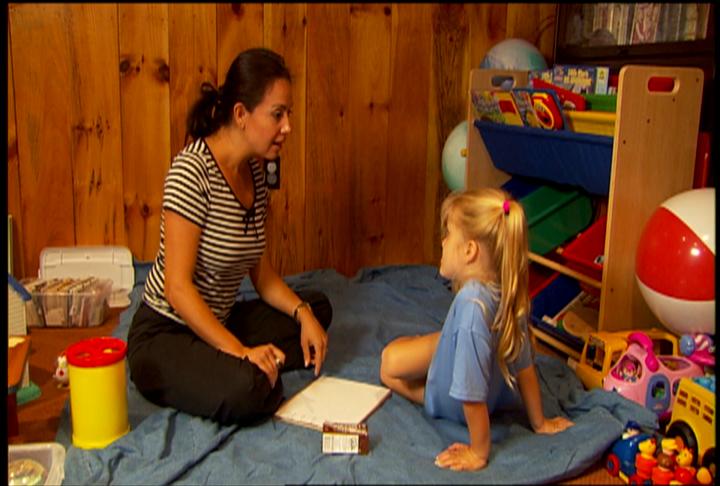
Over time, when the space is marked off, the child will know it is time for learning. When you take the marker away, the learning area becomes just a part of the room again. In the following clip, watch how the teacher stays calm and redirects the child to his learning place when he tries to leave. She prompts him to stay in the learning place until the learning session is finished.
If you have a small table and chair for the child, that may work especially well. This is because a chair tends to keep the child sitting up straight in a good position for paying attention and learning. Also, a table provides a nice boundary, as well as a good work surface for materials. But it’s fine to sit on the floor, to begin with, if that is what your child is used to. What is important is that the child can pay good attention to you whether he is seated in a chair or on the floor. In the next clip, the teacher and child are sitting face-to-face on the floor.
In the following two clips, notice that the children are sitting in chairs and the teachers are sitting in low, child-sized chairs so that it is easy for the children to look into their eyes. Here the teacher praises the little boy for imitating her, but also notice how she pairs her praise with a treat. She holds the treat up to her eyes so that he will look at her before he gets the treat.
Here the teacher reinforces the child for imitating her actions using objects. Notice how she pairs her praise with something the child really loves:
In the following clip, notice how the teacher is sitting on the floor so that she is eye-to-eye with the child. She is reinforcing matching with tickles and eye contact games including peek-a-boo.
If your child is still sitting in a high chair with a tray at mealtimes, you can sit face-to-face with him while he is in his high chair. You can do this before, during or after a small snack. If he’s ready for his snack and enjoys what you are going to serve him, you could use pieces of his snack as rewards. Here the child is confined in his high chair, but his teacher is doing everything she can to make learning fun and he doesn’t seem to mind at all. He really seems to enjoy being tickled with a pom-pom.
Here’s another teacher working on imitation with a baby in a high chair. She models simple actions for the baby to copy. The baby still needs help. The teacher is prompting using gentle physical guidance. Notice how joyful the teacher is. She reinforces the baby with enthusiastic praise paired with a treat. She offers these reinforcers with the same enthusiasm, whether or not the baby imitates the teacher’s actions all by herself or with a prompt.
Some children are happy to sit with you from the beginning. It helps if you begin by playing with them using their favorite toys or activities. Often, however, children become used to doing only the things they want to do, and only when they initiate the activity. Or, they may prefer to play by themselves. Sometimes they resist when adults try to sit them down and play with them or teach them new things. At first, they may cry and try to run away from the learning area. In that case, the high chair might be a good place to start. But if your child is no longer using a high chair, a small corner of a room might work well. If you position yourself between your child and the more open middle areas of the room, it will be more difficult for him to run away and he may be less likely to try.
Having a Second Person Sit Behind the Child can be Very Helpful
If you have a friend or family member to help you, it may work well to have a familiar person sitting behind the child. That person can even prompt from behind once you show them how. In the following clip, notice how enthusiastic the adults are. The child gets lots of reinforcement even though she still needs physical prompts to respond correctly.
Try to Make the Learning Place as Free of Distraction as Possible
We will refer to the area where you have your special learning sessions as the “learning place.” We will call the rest of the home and other places the child goes, the “natural environment.” If possible, try to have learning sessions when the house is quiet. Times when other children are away at school, playing outside, in another room, or sleeping, work well. If you have a TV nearby, make sure it is turned off. Also, it will be helpful to keep the learning place clear of distractions. Things like toys or other objects can take the child’s attention away from you and the one or two toys or objects you have chosen for your lesson time. You want to make it easy for your child to pay attention to you, especially when he’s getting used to his learning sessions.
Be Prepared for Your Child to Resist Staying in One Place
The easiest way to teach your child to enjoy learning with you in this space is to make it fun for him to do so. And it is also very important to make it easy for him to be successful. Then you will have plenty of opportunities to reinforce him. We will talk about that next. However, as we said, some children have a particularly difficult time getting used to staying in one place. In some cases, even when parents and teachers do a very good job of trying to make learning sessions fun, children will resist sitting in the learning place. Some will have tantrums. Don’t worry, that happens sometimes. In this section, we will give you a few suggestions on how to deal with non-cooperation. Non-cooperation is when a child does not do what he is asked to do. We will also talk a little bit about how to prevent problem behavior. Module 6 also deals with the prevention and handling of problem behavior.
Beginning to Establish Cooperation
The very first thing your child needs to learn is that when he’s in his learning place, he needs to sit nicely and pay attention to you. You can start by just sitting in this space with your child, quietly playing with him doing something he enjoys. Playing with his favorite toy or doing his favorite activity often works best. In the very beginning, this can be for just a few seconds or for several minutes. This will depend upon how interested your child seems to be in the activity. But try to stop before he loses interest. What’s important is that he is learning that this is a quiet space where the two of you will do things together. You want this to become a space that he enjoys. Most important of all, you want him to look forward to spending time with you, and to try and do what you ask. For these reasons, it’s important to do things that he will enjoy from the very beginning.
In the following clip, the teacher is just beginning to help this little girl get used to the idea of staying at the table with her and following simple instructions. In other words, she is working on establishing cooperation. She is using a noisy shape sorter toy that the child already really likes. Notice how the teacher gives the child all the help she needs to put the pieces in correctly so that they make the reinforcing noise. Also, each time she holds up a piece of the toy, she requires the child to make eye contact before handing her the piece. In this way she is working on eye contact too. The child is learning how to use the toy correctly, and that’s great. However, that is not actually the teacher’s main goal here. Right now, she’s interested in teaching the child about their special learning sessions. She wants the child to understand that they will do fun learning activities together in this special learning place. While having fun together, it will also be important for the child to learn that she should pay attention to her teacher. She should also try her best to do as her teacher asks.
Did you notice how the teacher redirected the little girl to keep her engaged? She gently guided her to play with the shape sorter pieces instead of just spinning the small shapes attached to the bottom of the toy. The teacher allowed her to spin the small shapes in between trials of putting the shapes into the sorter. She helped the child as much as was needed to keep her engaged and cooperative.
The child remained engaged and compliant. She stayed in the learning place for the time it took to complete the shape sorter toy twice.
In the next two clips, watch as another teacher is working on establishing cooperation with a baby in a high chair. In the first clip, she is helping him to make a very simple, three-piece puzzle. She is also helping the baby shape his fingers into a point so he can point to the puzzle pieces he wants. Notice how the teacher gives him just as much help as he needs. She also gives him lots of enthusiastic praise, paired with treats, for following her instructions. In the second clip, she is instructing him to put four Lego pieces into a box, one-by-one. She has chosen easy tasks so that he is sure to be successful.
In both of these clips, the teacher’s main goal is to begin to establish cooperation. She wants the child to learn that when she gives him an instruction, he should do his best to do as she has asked. She gives him all the help he needs to be successful and lots of enthusiastic praise, paired with treats. In the end, he remains happily engaged and cooperative throughout two simple activities. Once he is finished, the teacher can decide whether or not to try for another quick activity. Or, she can choose to take him out of the high chair and take a break from the learning session.