

Keep A Food Diary
While you’re working on making mealtimes more pleasant, focus on your child’s eating habits to better understand what he likes. You should do this before you start trying to expand the foods he will eat.
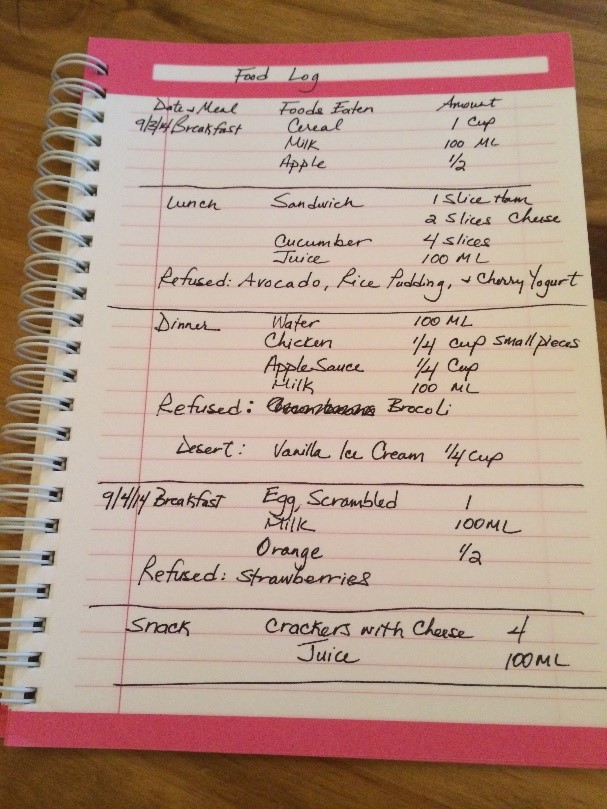
What information will you need? What should you keep track of, before you get started? We suggest that you keep a food diary for at least a week or two. Do this before you start to work on expanding the foods your child will eat. Keeping a food diary means that at each meal and snack, you write down everything your child eats, and about how much. You also write down the things he refuses. For example, you might write that for breakfast on a certain day, he ate: a cup of cheerios with half a glass of milk (about 4 oz.) and half of an apple cut up. Or you might write that for lunch on a certain day, he ate a sandwich with two pieces of whole wheat bread, one slice of bologna, and two slices of cheese. Or one jar of baby applesauce and one-half cup of rice baby food. You should also write down any foods that your child refuses. For example, you might write that he refused avocado, rice pudding and cherry yogurt.
Keeping a food diary will help you to see if there are any patterns in which your child will and won’t eat.
Here is an example of a typical page from a food diary:
Look for Patterns In Your Child’s Eating Habits
Keeping a food diary like this will help you to see if there are any patterns in what your child will and won’t eat. For example, some children refuse foods with specific textures. This might be things that are crunchy and hard, or things that are mushy and soft. Some children refuse foods that are hot or cold, liking food at room temperature. Some children like foods with strong flavors, like salt or spice. Others will eat only bland foods without strong flavors, like rice, crackers or potatoes. Most children like sweet foods. Some children prefer salty treats, like potato chips, corn chips or popcorn. Many children have a strict set of rules about the foods they will and will not eat. Here are some examples that may or may not sound familiar to you.
|
Examples of “Rules” about Food:
|
Having a food diary will also help your child’s doctor or a nutritionist get a clear picture of your child’s diet. This will be helpful if you’re concerned about whether or not he’s getting adequate nutrition.
When To Delay Food Training
We want to make one more important point, before we talk about things you can try to expand the foods your child will try. If your child is still learning to request by pointing or using the Picture Exchange Communication System (PECS) or saying what he wants, this is probably not a great time to work on food choices. It’s very important that he has a way to request the things he wants first. As we said when we talked about how to teach requesting, you will probably want to use meal or snack times to help him to request his favorite foods. He won’t make much effort to request foods he doesn’t know or like. So, if you stick with your child’s preferred foods at meal and snack times, you will have more chances to practice requesting.
Also, if your child hasn’t learned to follow simple instructions, for example, to sit, or look at you, or to hand you something, it might be best to wait. In other words, he might still be in the baby stage of doing whatever he likes and not paying attention to what you want him to do. If this is true, this is probably not a good time to get him to accept new foods. It will be best to focus on teaching your child to request the things he wants and on helping him to follow some simple instructions. Skills like imitating you doing things like clapping, or matching two identical objects, are generally easier to teach than trying new foods. This is especially true for a child who really does not like new foods. If that’s the case for your child, just continue to work on making mealtimes more positive. Try to avoid putting pressure on your child to try new foods. Continue to serve a wide variety of foods to others at the table so he has a chance to get used to their sight and smell.
Shaping Acceptance of New or Non-Preferred Foods on the Plate
Here’s something you can do, whenever you get the chance, during the cool-down period. You can do this even if expanding foods he will eat is not very important for the time being. Place a serving bowl or plate with a food that is new to the child, or a food that he doesn’t like, on the table. To begin with, put the bowl or plate at least a couple of feet away from the child. At each meal, move this serving bowl a tiny bit closer to where your child is sitting. If he gets upset, don’t move the food away. However, at the next meal, put the food a bit farther away from him and keep it like that for several meals before trying to put it a tiny bit closer again. You can expect that food with a stronger smell might have to be a bit farther away to begin with and moved closer to your child even more gradually.
If this goes well, try putting just a tiny amount – even less than a full bite – of the new food on your child’s plate but do not even encourage him to taste it. Just leave it there. If he eats some of it, or even tastes it, show him how pleased you are, but do not encourage him to do so. Don’t move to the next phase of learning to eat new foods until your child is able to accept the presence of a variety of new foods very near his place at the table and preferably on his plate. And remember, at this point you will still be a long way off from even encouraging him to taste anything new.