

Including Others In Play
When playing with your child, you want him to be including you in some way, even if it’s just by looking at you. If your child already knows how to imitate, you may find that if you play right next to him, with the same type of toy, he will imitate you. Try switching back and forth between imitating his play and demonstrating new ways to play with the toy. That may be enough to get him to switch his attention between his play and yours.
Sometimes we think we are playing well with children if we sit next to them and narrate their actions. This means that we keep talking about what they are doing. But this doesn’t encourage back and forth interaction. When playing with your child, think, “Could he be doing the same thing if I were in another room?”
When playing with your child, think, “Could he be doing the same thing if I were in another room?” If the answer is “yes” you may have to work a little harder to make sure he’s checking in with you and paying attention to your face and reactions.
If the answer is “yes” you may have to work a little harder. Make sure he’s checking in with you and paying attention to your face and actions. Try to keep track of roughly how long your child plays with a toy before looking at you or including you in some way. If he goes more than a minute or so, you could say, “My turn,” in a playful tone of voice. Then, gently take the toy and put it on your head with a big smile or do something else with it that’s fun or silly. As soon as he looks at you, give it back to him and say, “your turn!” Or, you might try being the “keeper” of the toys. For example, when playing with toys that have pieces, you may have to keep all of the pieces behind your back or in your lap. That way, your child has to look at you or point when he wants one.
In the next two videos, watch how the teacher gets the child interested in the toy. She then uses it to get eye contact and provides as much help as the child needs to use the toy. In the second video, the teacher also helps the child to point to the next puzzle piece.
STARTING TO PRETEND
Another important thing to work on is helping your child start to understand and enjoy pretend play. You can do this by demonstrating very simple pretend. You could pretend to drink from a cup the child can see is empty or pretend to feed a baby doll or stuffed animal during meal or snack times. Or, just before bedtime, you can help your child to put one of his dolls or stuffed animals to bed and give it a kiss goodnight! When you do these things, be sure to show your child that pretend play is fun and that you are enjoying pretending things with him, as in the video below.
Notice how the teacher acts out each action for the child. She then prompts him, when necessary. She also reinforces him for imitating her pretend play. She does this by responding enthusiastically and expanding on the play theme.
Here’s another idea for how to introduce the idea of pretending. If something happened that provoked an emotional reaction in your child, you can re-enact this with him. The emotion can be either positive or negative. Make sure to wait until after he’s calmed down. Acting out a similar scene with a doll may help your child understand what happened. It can also help him understand the idea of pretending. For example, say your child fell and bumped his knee and cried. After you have comforted him and he feels better, you could act that out with a doll. You could do this by making the doll fall and cry, then kissing the doll’s pretend booboo. You could have your child kiss the doll’s pretend booboo and help you apply a Band-Aid. Then say, “Now he feels all better.”
Module 14 has a lot more information about the development of pretending and how to help your child understand and enjoy it.
ENCOURAGE IMITATION
Imitation is a wonderful foundation skill. If a child can imitate your actions, it will be easier for him to learn to pretend, and to learn words. Your child will also be able to learn skills such as feeding himself and dressing himself. For example, he can watch you use a spoon or fork, and then imitate you with his own spoon or fork. He can learn to do things like throwing or kicking a ball in the same way.
You can demonstrate very simple actions such as raising your arms to show your child what to do while you’re dressing him. When you have his shirt ready to put on, raise both of your arms in the air. Then say, “Arms up” in a happy tone of voice. If he imitates you, give him enthusiastic praise and a tickle or something else he likes. Do this before putting on his shirt. If he doesn’t try to imitate you, help him by gently taking his hands and raising them upward. Then praise him just as if he did it all by himself. Try again a few times before putting on his shirt. But remember, in order for a child to imitate you, he must first be paying attention to you.
You can look for many chances throughout the day to have your child imitate your actions. For example:
Encourage your child to copy you whenever you’re doing something you think he might enjoy. |
In the following clip, notice how the younger girl is imitating her older sister and her mother. They are pretending to have a little tea party. Because this child already has imitation skills, working on pretend play with her is easy and fun.
If your child can imitate sounds and words, this will help a great deal in teaching him how to say the words for the things he wants, or wants to show you. For example, he might be pointing to a cup of juice or handing you a picture of juice in order to request it. In this case, you can give him a verbal model of the word “juice” that he can imitate. This way, he can practice saying the word “juice” while requesting it with a point or a picture.
Or, say you are outside, and a low-flying airplane is flying overhead. Your child is staring at it intently. You could point to the plane or prompt your child to do so. Then say, “Airplane!” or “Plane!” Say the word clearly and a little slowly. Make sure to stress the first sound of the word. Even if your child doesn’t imitate the model, show your enthusiasm with a broad smile. You want him to know that you are enjoying sharing the experience with him.
CHANGE A ROUTINE IN A FUNNY WAY
Once a child has learned a routine, he can find it surprising and funny if you start the routine in the same way as always but then do something different. This is a fun way to get your child’s attention. It also keeps him interested in paying attention to you. For example, you could try putting only one inch of water in the bathtub or using a slotted spoon to serve soup. When you get his attention, make a fuss about it. Say something like, “Oh mommy is so silly! She forgot all the water!” or “Mommy is so silly. That spoon won’t work!” This will help him to pay attention to what you’re doing. It will also develop his sense of humor.
INVOLVE OTHER FAMILY MEMBERS
If you have an older child in the house who can do some of these activities with him, your little one may enjoy doing these activities with his older brother or sister. Doing the activities with other adults will help too. A second parent, a relative, a babysitter, or a close friend can all participate. This will help the child gain other close relationships. He will also learn to carry over the feelings and skills you are encouraging.
Doing the games and routines with more than one person should help him to be more flexible with those skills. It should also get him to use the skills more often and in different kinds of situations. These familiar adults can also help keep the child happy and socially engaged when you are not around.
If there is a sibling, family friend, or another close family member who is around the same age as your child, or within a couple of years, it may be very helpful to involve the other child in the play at the same time. This mom is helping the autistic child’s brother to play with him.
Many children find it hard to share a toy. In this case, give each of the two children a similar toy and have them play side-by-side. You can give each child the same toy if you have two. The benefit of giving two children the same thing to play with at the same time, is that if your child can imitate others, he will have a nice model of good play. If he doesn’t yet imitate others, you could prompt him to do some of the same things with the toy that the other child does, and then praise him for doing that. Hopefully, he will discover that he enjoys these new ways of playing with his toys. Sometimes children who are not really interested in paying attention to adults will be interested in paying attention to other children.
TURN TAKING
Teaching children to spend their time doing things that are good for their development and giving them a lot of reinforcement for doing these things, goes a long way toward preventing problem behavior. Teaching children to take turns and share treats and toys is a great way to prevent problem behaviors like grabbing toys away from others or having tantrums when another child plays with a favorite toy.
In the next clip, watch as the little boy’s mother tries to share the activity of building a block tower with him. At first, he swipes at the tower and knocks it down whenever she adds a block. She just presses on, continuing to encourage his turn-taking. She doesn’t tell him not to knock it down or even to wait. She just keeps going with the turn-taking. They build a little tower together and then he enjoys knocking it down!
If your child can match identical pictures and likes playing matching games, you can start teaching your child to take turns with simple board games. Lotto boards (loto or Loteria in Spanish) work well for this. Each child has a board with pictures on it. See below, where each child’s board has 6 pictures. Put a copy of each picture on the floor or table between the two children’s boards (see picture below).
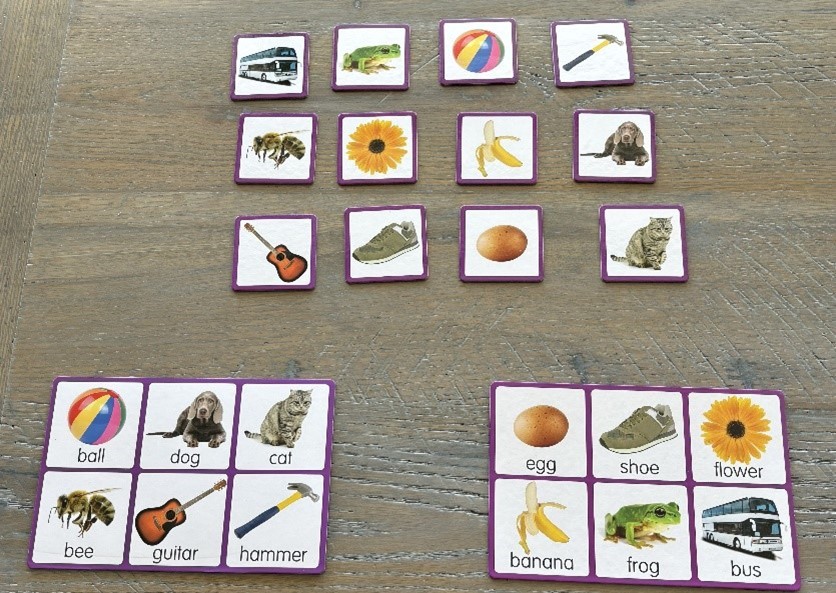
Then, just let the children take turns choosing a picture that matches one of the pictures on their lotto board and putting it on the matching picture, until both boards are filled.
Before they begin to play, decide which child will go first by flipping a coin or using any other method that you have used before. Assure the child that goes second, that he will go first next time.
Ideally, you want to teach your child to let the other child know whose turn it is. If your child can say the words “My turn,” and “Your turn,” and can imitate you when you model the language for him, great! But if your child cannot yet say words, he can still communicate this with gestures, by placing his open palm on his chest to indicate, “My turn,” and by pointing to the other child to indicate, “Your turn.”
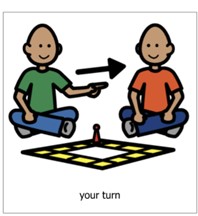
Another option would be for the child to use a picture or icon. In this case, hand the child who is going to go first, an icon that depicts, “My turn.”

Then, your child should take his turn before picking up the “Your turn,” icon and handing it to the other child.
Another way to do this would be to place the pictures on a moveable surface, like a lightweight cutting board, instead of placing them directly on the table.

When it is your child’s turn, put the board with the pictures in front of him. After he chooses one, prompt him to gently push the cutting board with the pictures over to the other child. After the other child takes his turn, have him push the board back to your child and so on.
You can also combine these approaches. Your child can use words, gestures and/or pictures in any combination that works for him. The important thing is that he begins to understand the concept of turn taking. You want him to learn that his turn is coming and to wait patiently when it is not yet his turn.
There are many other activities that promote turn taking, or reciprocity. These activities usually require that children look at one another or are at least aware of what the other is doing. Here are a few ideas. You can use the “My turn/Your turn” gestures, words, or icons with many of these activities.
- Playing “I spy” with books – Using a book that has several pictures on each page, the children can take turns saying, “I see a [dog]”. Then, the child should point to the picture they have labeled.
- Turn taking with simple board games – If your child knows how to play games with dice or a spinner, passing the dice or the spinner back and forth is a good way to indicate when one child’s turn has finished and the other child’s turn is starting.
- Say and do (sometimes called Simon Says, or Mother May I?)
- Playing catch (or rolling) a balloon, or large, soft ball, back and forth.
- Rolling a truck back and forth –If you have a small toy truck, put a small treat in the open part of the truck each time it gets pushed from one child to the other.
Next: Teach Skills At or Just Above Your Child’s Current Level