

Following Simple Instructions with Objects
Give Simple, Clear Instructions Your Child will WANT to Follow
An easy way to start working on cooperation is to give your child directions that he is very likely to follow. For example, you can say “eat the cookie” as you are handing him a small piece of a cookie that you know he likes. Then, praise him for doing what you told him to do. Or you could say, “play with the car” while handing him a favorite toy car. If your child has a toy with pieces that he enjoys putting together you can hand him pieces, one or two at a time, and instruct him to play with the toy. For example, as you hand him a piece of his favorite shape sorter, say, “in”. Or, you could say, “here” as you point to where it goes. Using a familiar object, and a gesture like a point if he needs it, should help your child understand what you would like him to do.
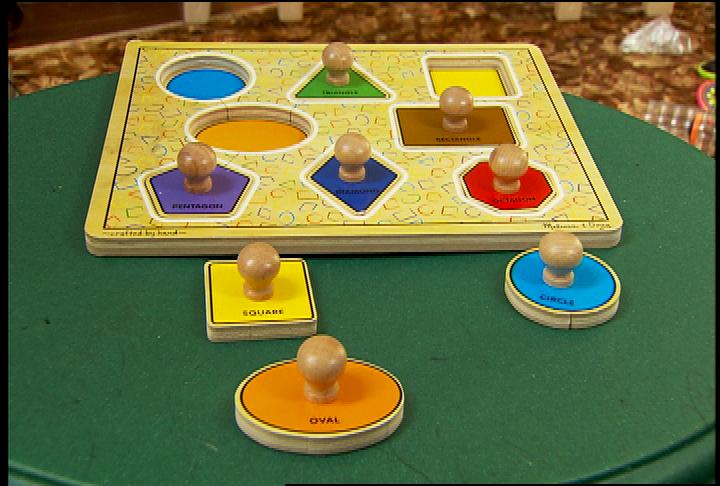
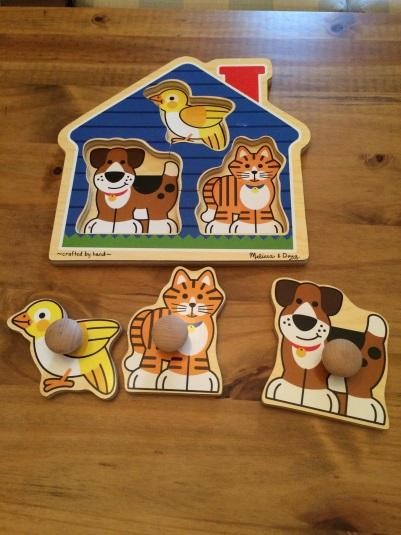
If your child enjoys playing with an easy puzzle, you can give him the puzzle board and then hand him a puzzle piece while instructing him to put the piece “in” the puzzle board. Be sure to give him all the help he needs to follow your instructions as the teacher does in the following clip.
Did you notice that the teacher used very simple language; “Put in.” When we talk to children who are very young, or don’t yet understand many words, we use very simple, clear language. This is especially important when we are teaching a new skill. Even though the child clearly wanted to try and put the pieces in anyway, his teacher was telling him to put the pieces “in” and then reinforcing him for doing so. She paired her praise with little tickles using a soft make-up brush or a feather. Then, when he finished the puzzle, she gave him a piece of a favorite cereal. By instructing him to do something he wants to do anyway, she is looking for opportunities to reinforce him for cooperation. In other words, she is rewarding him for doing what he is asked to do.
When talking to children who are very young, or seem to have some difficulty understanding language, it’s a good idea to use very simple, clear language.
The piece of cereal served another purpose as well. You might have noticed that the first time he finished the puzzle he began to fuss a little when she tried to take it away. However, the second time he did the puzzle, she was ready with the piece of cereal and handed it to him as she was removing the puzzle. This made it easy to move on to a new task while he was happily enjoying his treat. Let’s watch the very end of that last clip again. Notice how she is ready with the treat and uses it to distract him from reaching for the puzzle again.
You can do the same thing using pegs and a peg board or small objects going into a cup or bowl. Each time you hand the child a piece, say ‘put in’ or even just ‘in’. You can work on compliance with stacking toys too. You would just say, “Put on” or, “Put it on top” instead of ‘in’ or ‘put in’. You could use any toy or activity that you think your child may enjoy. Remember to praise your child and show him that you are pleased with him each time he does anything that you have told him to do, even if it’s something you know he likes doing anyway. By doing this, you will increase the chance that your child with cooperate with your instructions in the future.
Remember to praise your child and show him that you are pleased with him each time he does anything that you have told him to do, even if it’s something you know he likes doing anyway.
In the next clip, the teacher is working on cooperation in the learning place. She is asking the child to put either a block or a spoon into a cup. He already knows how to do this. However, by asking him to do very simple things, and then reinforcing him with treats and praise, she is trying to encourage cooperation.
Here is the same little boy following instructions to put the pieces of Mr. Potato Head “in.” He has already learned to point to things to request them. So, the teacher is having him practice requesting by choosing the pieces, one at a time.
For a child that doesn’t yet know how to put Mr. Potato Head together, you could just remove one or two pieces. For example, remove only the eyes and one of the ears. Then, as you hand him the pieces, one at a time, you could instruct him to put them “in”. Give him as much help as he needs.
You can prompt by pointing to the correct hole or helping him to push the piece into the hole. Be sure to praise him either way, followed by a little treat.
A Reminder about Using Prompts
If your child does not do as you have asked within a few seconds or if you think he may need help to do it properly, you should prompt him. Do this by placing your hand over his, and physically helping him to do what you have asked. Then you should praise him as if he had done it by himself.
Do you remember what this kind of prompt is called? This kind of prompt is called a physical prompt. Sometimes we also refer to it as a “hand-over-hand prompt.” This is because we are literally using our own hand to make the child’s hand do something in a certain way. Remember, we often have to prompt children to help them learn new things. Over time, we want to prompt them less and less until they can do it on their own. As we have discussed, we gradually reduce the amount of help or prompts required to make sure the child is responding correctly, all by himself. We call this “prompt fading”. While it is very important to give your child all the help he needs to be successful, it is also important to gradually fade your prompts. You must reduce the amount of help you give until your child is able to respond correctly all by himself. If you take too long to fade the prompts, there is a risk your child will come to depend on the prompts and wait for your help before even trying to do things on his own.
Use a Lot of Reinforcement in your Child’s First Learning Sessions
Always reward your child with enthusiastic praise and/or a treat of some kind after each time he does what you ask of him. This will teach him to pay attention to you and to do the things you tell him to do. Over time, you will not need to reward every try. But in the beginning, it’s better to do so. This way, you will probably have an easier time teaching your child to sit nicely with you during your learning sessions.
Use Tasks that Have a Clear Beginning & End
Another important way to teach your child how to be a good learner is to make sure that he doesn’t stop an activity in the middle. One way to do this is by instructing your child to complete a task that has a clear beginning and end. For example, if your child enjoys playing with puzzles, you could begin by instructing him to do a very simple puzzle. When the puzzle is finished, praise him enthusiastically and then offer him a really fun activity. It is important to begin with a task that is very easy. Ideally, the task should also be one your child enjoys. Remember that the only new skill you are trying to teach right now is how to behave in his learning sessions. You want to teach him to pay attention and do what you ask him to do. And you want him to finish the tasks he starts.
If your child has a hard time sitting in one place, give him a short task that he enjoys, and is able to do with little or no help. As soon as he has completed the task, reward him enthusiastically and offer him a break. The break activity should be away from the learning space. And try to find an activity that gets him up and moving around.
If you can succeed in teaching your child how to pay attention to you, and try his best to follow your directions, you will be able to teach him many things later on. You may be eager to teach him a lot of new things right away. However, you must first teach him to do what you say during your learning sessions. For this reason, it’s best to begin with tasks your child already knows how to do. For example, say your child can do a puzzle with eight pieces, but doesn’t always finish. In that case, you might want to begin with a three-piece puzzle. If you don’t have any easier ones on hand, you can begin with an 8-piece puzzle that has five of the pieces already in place.
Teach New Tasks Using a Step-By-Step Approach
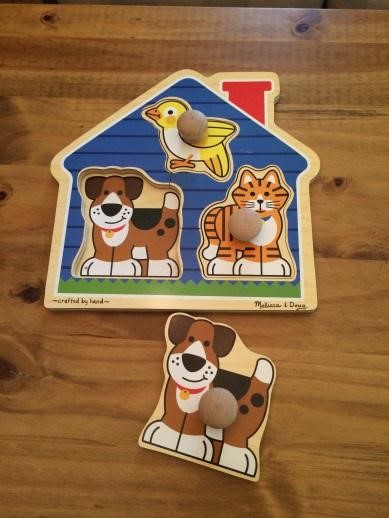
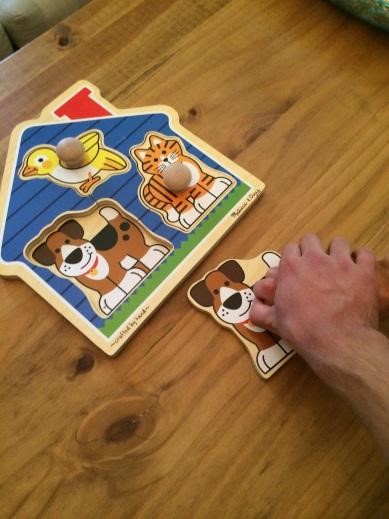
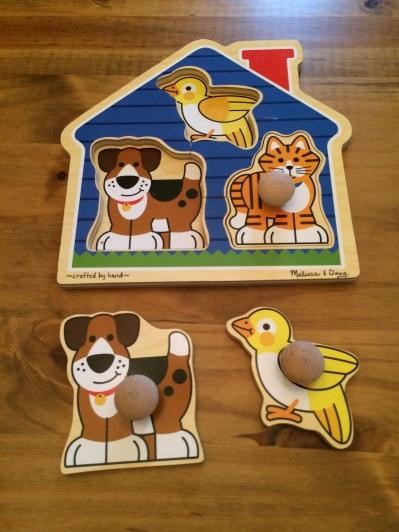
If your child doesn’t know how to do puzzles, you can teach him using a very simple puzzle, and start by removing only one piece. Tell him to make the puzzle, or say, “Do puzzle.” Then give him as much help as he needs to put in the missing piece, followed by praise and a treat. And remember to reward him even if you had to help. When he is able to do one piece by himself, remove two pieces and require him to do both pieces for the treat and so on.
Step 1
Step 2
Step 3
You can do the same thing with many toys. For example, the circle is the easiest of the shapes to put into a shape sorter. You can put the other shapes away and cover the other holes with your hand so that only the circle is open. Once your child can easily place the circle in the circle hole, uncover a second hole and see if he can find the circle hole and put the circle in. After he can do that, offer him two pieces and so on.
Or, if you have a Mr. Potato Head toy, you can leave all of the pieces in place except for the eyes or the nose. Then hand the child the one piece that is missing and instruct him to put it in, pointing to the empty hole and prompting hand over hand if necessary. Once that is done, the task is complete. After he can put in one piece, start by removing two pieces, and so on. If he starts having a hard time when you remove two or more pieces, go back to just having him put in the one piece and give him lots of praise for that. When you think he might be ready, go back to taking away two pieces. No matter what, give him lots of praise for trying. At first, your child will be sitting and complying with you for only a few seconds and putting in only a single piece of a puzzle or toy. However, as time goes by, he will be sitting with you, and doing what you ask of him, for longer and longer periods of time.
At first, your child will be required to sit and comply with you for only a few seconds, doing only a one-step task. As you add steps to the task, he will be sitting with you, and doing what you ask of him, for longer and longer periods of time.
Another idea would be to place a cup, bowl or any other type of container in front of your child. Then place two or three blocks or other small objects where he can see them clearly. Say, for example, “Blocks in bowl,” or even just, “Blocks in”. Use very simple language to tell him to put the objects ‘in’ the container. Help by prompting him as much or as little as needed. For example, pointing to the blocks and the bowl or gently helping him move the blocks into the bowl. As soon as all the blocks are in the bowl, offer him a little treat right away, and then a short break with a really fun activity. Nothing helps a child learn like being successful! So, it’s a good idea to start with something your child is sure to be able to do easily.
Gradually make the sitting times longer. You can do this by having your child complete tasks that take a little longer to finish. For example, if your child begins by placing three blocks into a bowl, gradually increase the amount of time by adding more blocks.
Here’s another example. The teacher is gradually increasing the time the child spends engaged in learning. She does this by removing more puzzle pieces each time the child makes the puzzle.
And you can use the same strategy to teach your child to string beads. Begin with just one bead and add one or two at a time until he is able to string all of the beads.
These ideas are just examples. You can use any toys or materials that you think your child might enjoy. If you aren’t sure, it may be very helpful to watch him and pay close attention to what he does when he can do whatever he likes. Then see if you can think of a couple of similar activities. Try to use toys or materials that he tends to choose on his own.
Teach your child to complete a few different activities, from start to finish. For example, teach him to put together a puzzle, to put blocks into a bowl, and to string beads. Then you can work on having him complete two easy tasks, instead of just one, before you offer him a break. Remember to place both tasks in front of him from the very beginning. That way, he’ll know what will be expected of him. When you first try to teach him to complete two activities before earning his break, don’t be surprised if he resists the second activity. Remember, he may have liked getting a break and a treat after completing just one task. That’s why it’s important not to stay with only one activity for too long. Over time he will learn that breaks will come when he completes the toys or tasks placed in front of him. In the following clip, watch how this little boy is learning to complete two whole tasks. He makes a puzzle. Then he puts together the Mr. Potato Head toy before getting a play break away from his workplace with a special helicopter toy.