

Following A Point
There’s one last thing we would like to add about pointing. In addition to being able to point, your child needs to be able to follow your point. This means that when you point to something to show it to him, he should know what you are pointing to. If your child knows the words for the things you are pointing to, he should be able to tell you what you are pointing to. If he understands the word “get” he should be able to bring you the object you point to when you say, “Get that one.” This is usually not very hard to teach. We will give you a few ideas. You will probably come up with some great ideas for your child on your own as well. One of the easiest things to do is to place pieces of your child’s favorite treats or toys around the room. Point to them one at a time, giving your child a chance to go and collect each one in turn.
If following a point is difficult for your child, you might even have to start where you’re actually touching the object with your pointer finger. Gradually move it farther away. For example, if a treat or toy is hidden under a cup, you could point to the correct cup first by touching it. Gradually start pointing to the cup from farther and farther away.
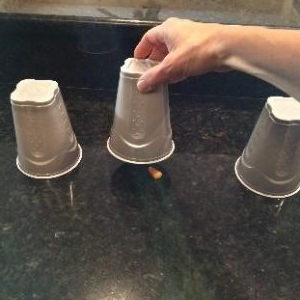
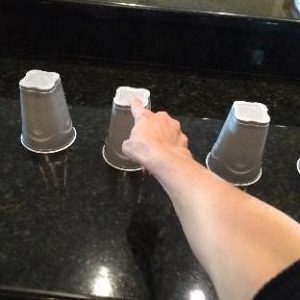
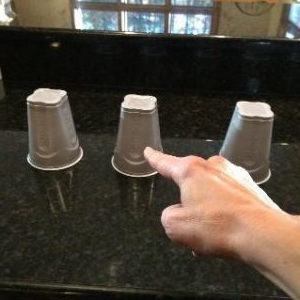
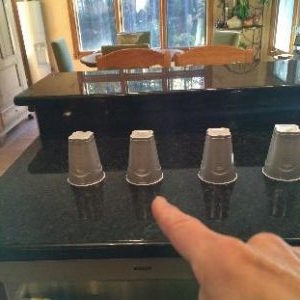
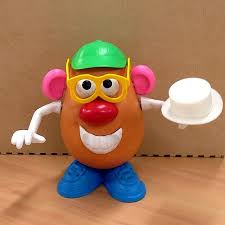
Here’s a clip showing how to work on teaching your child to follow a distal point using a Mr. Potato Head toy. The child’s reward for getting the item the teacher points to is to put the piece into the Mr. Potato Head. She also gives him lots of happy praise!
Following Eye Gaze
In the last clip, did you notice how the teacher had placed some of the pieces of Mr. Potato Head close to her and others further away (“distal” means farther away)? She began by pointing to things that were very close. She then started pointing to things that were a little farther away. The last things she pointed to were half-way across the room. Did you also notice that the teacher tried using only eye gaze to show the child where the last two pieces of the toy were?
She looked toward where the pieces were and the child had to figure out where she was looking. Knowing what another person is looking at gives an idea of what they are paying attention to. This is another important skill that usually starts around the first birthday. You can imagine how this can play an important role in communication. If an adult looks across the room or out the window with a scared face, it is important for the child to figure out what is scaring her and might be dangerous. If she smiles and claps her hands, the child needs to figure out what the nice surprise is and where it is.
When you are teaching your child language, you can look at the cup and say “cup.” If the child can tell what you are looking at, that will help him learn what the word “cup” means. Following another person’s eye gaze is another important building block of social communication. Once your child can follow your distal (far away) point well, you can use the same kinds of games to work on eye gaze.
When first teaching eye gaze, sit across from the child and place three objects on a table between you. Make sure that the objects are far enough away from each other to make it easy to tell which one you are looking at.
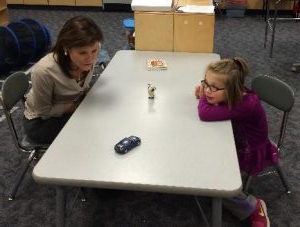
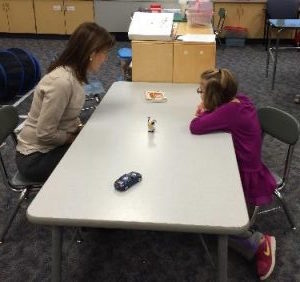
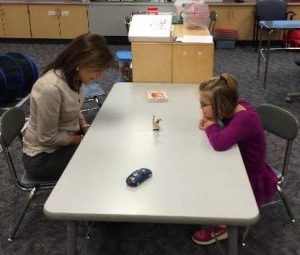
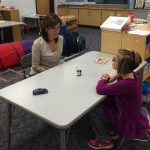
Like the teacher in these pictures, you should begin by “looking” with your head and upper body. Lean toward the object in an exaggerated way and look at the object you are leaning toward. But remember, this is a prompt. Like all prompts, it must be faded. Slowly fade your prompts until your child can follow your gaze when you are “looking” only with your eyes. Your child will have to look very carefully at your eyes to know where you are looking.
Once your child is able to make a distal point, plus eye contact, to ask you for things and to show you things, and he can also follow your distal point and/or your eye gaze, give him plenty of chances to practice these important skills. If you want your child to share experiences with you, it will be important for him to have experiences that are worth sharing. If your child loves animals, bring him to the zoo. If he loves cars, bring him to a car show. If he loves to slide down a slide, and swing on swings, bring him to the park. A trip to the mall or the toy store can provide plenty of chances for joint attention. A walk in the forest, collecting things like leaves, stones and pinecones or a walk on the beach looking for shells together, can also provide lots of opportunities for joint attention. Show your child things you think will make him feel excited and happy. The more wonderful things you can show him, the more likely he will be to pay attention to where you are pointing and looking. Focusing on you and other people is important for learning about social communication.