

Distracting with Fun Activities
It usually isn’t a good idea for a child to be wrapped up in his own thoughts and activities. This is because when this happens, the child tends to ignore other people. However, this is what we often see in toddlers who are at high likelihood for autism. When your child is wrapped up in his own thoughts or focusing closely on objects, it can sometimes be easiest just to let him enjoy himself in this way. In the next clip, watch as a little boy stares at the toy car and pays no attention to the adult.
Since the child does not want attention during these times, parents may use this time to get their own chores done. Or they may have seen the child become upset when interrupted. You might think your child somehow needs to do what he is doing. But – it is very important to work on increasing the amount of time your child spends engaged with other people. So in most cases, it’s easiest to just put away the toys that take his attention away from other people.
Often, the more you allow the child to stay wrapped up in isolating, self-absorbed activities, the more likely he will be to do it in the future.
The more you allow your child to stay wrapped up in isolating, self-focused activities, the more likely he will be to do it in the future. What you want to do instead is to try to get your child’s attention as often as you can. Make yourself a source of the fun!
The more you can engage with your child, the more you can compete with the objects or repetitive movements or sounds he finds so appealing. We understand that you have things you have to get done. That said, it’s really important for you to spend as much time as you can getting your child to interact with you in a fun way. And, it doesn’t always need to be a parent. No parent can spend all day with their child. It could be an older sibling, an aunt or uncle, a grandparent or a trusted caregiver. The important thing is that your child spends time paying attention to others and having fun.
How can you distract your child from a self-absorbed activity?
Many children engage in repetitive movements or sounds or play with the same toy or object in the exact same way, over and over again. While doing this, they tend to be focused ONLY on what they are doing. But they are not paying attention to the world around them. So, they are not learning from the world around them. We call this kind of self-absorbed activity “stereotypic behavior.”
Here are a few examples of stereotypic behaviors:
|
It’s important to note that many children engage in this type of behavior occasionally. However, children showing early signs of autism sometimes do these things over and over again. Some children can become so absorbed in these behaviors that they interfere with learning. Even so, you never want to scold or punish your child for this type of behavior. Instead, you want to distract him and engage him in something more fun. For example, your child might be very interested in waving a piece of paper in front of his eyes in a self-absorbed way. Instead, you can turn this activity into a social game of peek-a-boo using the same piece of paper.
Let’s take another example. The child in the next video clip has been playing with her bath toys in a repetitive way. She is very self-absorbed. Watch how her mother takes control of the items and is making herself a part of the game. She uses her child’s desire for the objects to work on eye contact. She doesn’t release the toy until her child makes eye contact with her. She even adds a new twist into the game.
Here’s another example. This same child is taking the magnets off the fridge and then putting them on again.. Watch how her teacher joins in on the routine to work on eye contact and social engagement. The teacher tries not to release the magnets until the child makes eye contact with her.
The teacher is having a hard time getting eye contact. She still makes it a joint activity and gets some eye contact. She does this by taking control of the magnets. She hands them to the child one at a time. She tries to hold onto the magnet until she gets at least brief eye contact.
Using the same toy or material that your child likes to play with repetitively can be a good way to get a child to play with others. Using his favorite things allows him to share fun with others rather than remain self-absorbed.
Sometimes it can be difficult to join a routine. In that case, you might need to alter the routine a little. For example, say your child likes to watch the wheels of a toy car spin round and round; a good idea would be to try something different with the same toy car. You could pretend to make the car race with another car. You could also make the car speed down a surface that is set on an incline. Your child might really enjoy these new ways of playing with his toy car. And he’ll be playing with you!
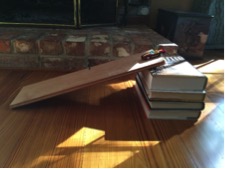
In the same way, if your child is flapping a piece of paper in front of his face you could make a paper airplane with it. Have fun with your child making it fly it through the air and chasing after it. If your child is flapping something soft and wiggly you could use it to play a tickle game.
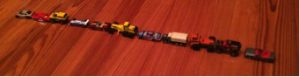
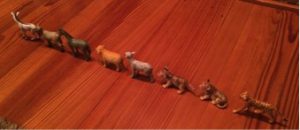
Some children showing early signs of autism also seem to enjoy lining things up. If your child does this, try to do other things with those same toys. For example, you could put on some music and pretend the animals are dancing together. Or you could set up a small track for the cars or the animals and pretend that they are racing. The important thing is to interrupt and redirect this kind of self-absorbed behavior. This is especially true if it is very repetitive.
Replace toys that lend themselves to stereotypic behavior with other toys. Try to think about other toys or things that work in the same way. If you find that your child likes to spin things, you could play with him using a top that he needs your help to spin. If your child often spins around himself, you could sing and play Ring-around the Rosie with him. You could also pretend that your child is an airplane and fly him around. The important thing is that you want to increase your child’s engagement with other people, especially YOU!
There may be times when your child is just so self-absorbed in his own play that you will not be able to find a way to join him. In that case, it is best to try and replace the toy that is taking his attention entirely away from you. Try to interest him in something different. Notice how this teacher gets the child’s attention. She persuades him to let go of the toy he is playing with in a self-absorbed way, in favor of interactive play with a balloon.
In some cases, it may be best to keep certain toys out of sight for a while. Then you don’t risk having to upset your child if you need to take them away.