

Cooperation Training
Teaching Cooperation in the Natural Environment During Everyday Activities
When we say “compliance” or “cooperation” we’re talking about your child doing what he’s been asked to do. If you ask your child to do something, and he doesn’t do it, there could be several reasons for this. One is that the child doesn’t understand what you’re asking him to do. A second reason is that he doesn’t know how to do what you’re asking him to do. For those issues, you should go back to teaching him to understand simple language or teaching him how to do the specific thing you’re asking. The third reason could be that he is not used to following instructions, and he doesn’t really want to follow them (he wants to do what he wants to do). For this child, it will be important to work on cooperation. That is, when you ask him to do something and he knows how to do it, he will cooperate with your request.
Many of your early learning sessions will be devoted to teaching skills that are not difficult for your child. In fact, early on we suggested giving your child very clear and simple instructions to do things that he can do easily and then reinforcing him for doing it. This is because it is very important to teach your child to cooperate with your instructions. For example, for a child that enjoys puzzles, if you hand him a single piece and say “Put in” or “In,” and then praise and tickle him when he does as you ask, you are not only strengthening his puzzle making skills but you are also reinforcing cooperation. Building cooperation is key to reducing non-cooperation! See this teacher reinforcing the little boy for something he likes to do.
Here’s another example of a teacher working on cooperation. She is instructing the child to do a task that is easy for him, mostly so that she has an opportunity to reward the child’s cooperation.
Try Not to Repeat Instructions
Building cooperation is important for your special learning sessions, but also an important goal to work on in the natural environment whenever you can. The easiest way to do this is to learn one important rule: when you give your child an instruction, say it only once. Of course, it is important to be sure you have your child’s attention before giving him an instruction. It’s often a good idea to go to your child and kneel or squat in front of him so that you are at his eye level before giving him an instruction that you want him to follow.
This probably sounds very simple to you, and it is, but it’s a very important thing to do. You can practice this with the instructions you give every day already! Here are just a few examples of things you probably ask your child to do, some of them several times a day:
Please…
…put your coat on.
…throw away the tissue.
…come here.
…give that to me.
…put that down.
…stop.
…put that away.
…put it in.
…take it out.
…wash your hands.
…put on your shoes.
…take off your shoes.
…sit down.
The only difference is that from now on, when you give your child an instruction, be sure to use clear and simple language and then wait only 3 to 5 seconds for your child to cooperate with your instruction. If he does not cooperate, simply walk over to him, prompt him to do as you have instructed, by gently helping him do what you’ve asked, and then praise him for having done what you told him to do. You should be able to fade your prompts over time. And, of course, when your child does what you tell him to do, you should show him how pleased and proud of him you are, by praising him, paying lots of attention to him, and maybe even offering a special little treat now and then. And remember, try not to give instructions that you cannot prompt your child to do. For example, if your child does not like a certain food, you can offer it as a choice, but it’s best not to instruct or ask him to eat it since you cannot (and should not) force him to eat it. We will talk a lot more about feeding problems in Module 7 (Picky Eating). But let’s review the steps for building cooperation in your child’s everyday activities.
Teaching Cooperation
|
Teaching Cooperation During Your Special Learning Sessions: Tips for Smooth Transitions
Teaching cooperation during special learning sessions is important too. In Module 9 (Special Learning Sessions), we start with how to build cooperation during the early learning sessions. You do this by telling your child to do things he enjoys and then reinforcing him for doing those things. This is a good start.
But some children will not want to spend time in their special learning sessions, no matter how much fun you try to make it. This is especially true if you are moving from free play to a learning session. If this is hard for your child, here are a few ideas that might help to build cooperation in your special learning sessions.
Plan to begin your special learning sessions right after doing activities that are not a lot of fun. These could be things like getting dressed or doing a chore. This will make moving to the learning sessions easier than moving from something that’s a lot of fun, like playing outside.
Here’s another idea. Pick a few small, light weight toys that your child can easily hold in his hand and put them in a little basket. When it’s time to begin his special learning session, hand your child one of these little toys as you take his hand to lead him to the area you have set aside for your learning sessions. This may make him more willing to come.
Also, as we have said before, it will help to select some favorite toys and treats and use them as reinforcers only during your learning sessions. It is best to keep them out of sight except for during learning sessions. Don’t let your child have them at other times, at least for now. Always reinforce your child for coming with you nicely to him special learning place when you ask him to. And make sure to give him a special treat as soon as he gets there, just for coming along nicely.
Using A Token Board
For some children, it can help to know how many trials they must do before they get a break with a fun toy or activity. In an earlier section we showed you a few examples of children working with their teachers using token boards. Here’s a simple idea you could use with your child.
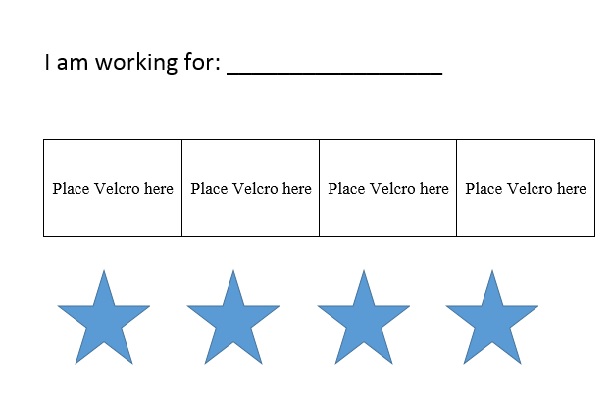
To use a token board like this one, cut out the stars and laminate them and the token board. (Laminating the stars and the token board is just to help them last, so you can use them over and over. Another way to help them last is to tape them onto a piece of cardboard before you cut them out. To help the token board last, you can slide it into a plastic sheet protector or cover it with a clear piece of plastic). Attach pieces of the soft, fuzzy part of Velcro to the back sides of the stars and to the back sides of pictures of reinforcers your child likes a lot. Attach pieces of the bristly side of the Velcro to the empty spaces on the token board. Place a picture of a toy, treat or activity that your child likes a lot to the top of the board, like a picture of swings or a cookie or bubbles. Here’s what it should look like:
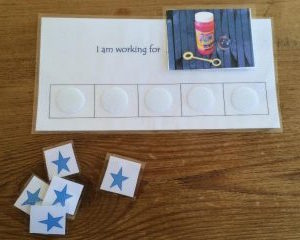
Each time your child completes a trial, Velcro one of the stars into one of the boxes as you praise your child. Praise your child right away. Then, make sure he sees you put the star in the box on the token board. As soon as the boxes are filled your child should immediately get the treat he’s been working for. In the following clip, you’ll see a boy working for tokens that are big yellow circles. You can make your tokens in any shape or size you like. Some children enjoy working for laminated stickers of their favorite cartoon characters and older children sometimes have coins or numbers for tokens.
Notice how the teacher gives the boy an extra token for a completely independent response, paired with enthusiastic praise. He also gets tokens for paying attention to his teacher with eye contact. This is a behavior his teacher wants to reinforce. As soon as the token board is filled, the child gets his painting toys to paint with.
You can make token boards for any number of trials you like, but it’s best to start with no more than two or three stars. Only slowly increase the number of trials your child must complete in order to fill his token board. Over time, he will pay closer and closer attention to the token board. That’s how you will know he is starting to understand that when it’s filled, he’s in for some fun or a treat! For some children, giving them a small treat (like a small popsicle or a few pieces of popcorn) will work better than anything else. But if you are using a picture of a small treat, make sure you have the treat available. It’s a good idea to use other things that the child likes (such as blowing bubbles, a favorite toy, a spin on a chair with wheels, being picked up and swung around), so you don’t have to always use food as your only reinforcer.


