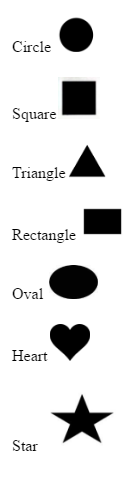
The method for teaching your child to label colors, shapes, familiar people and action words, is just the same as what we described for teaching the words for animals and objects. The only difference is that you’ll teach these words along with other words of the same type or category. And you’ll teach each of these categories as a separate teaching program.
You will use the exact same materials to teach expressive colors, shapes, familiar people and action words, that you used to teach your child receptive colors, shapes, familiar people and action words. And, you will teach these words in exactly the same way that we have just described above when we talked about teaching Expressive Labels. Here are the instructions as well as the item lists for each of these teaching programs.
Expressive Colors: (“What Color Is This?”)
- Sit knee-to-knee with your child.
- Hold up one color card in front of your child.
- Give a clear and simple instruction. For example, “What color is this?” or, “What color?” (Note that you do not need to use a verbal instruction on every trial.)
- Prompt, as needed, using a verbal imitation prompt. You can model the full word, part of the word, or just the first sound.
- Reinforce your child for labeling the color.
|
Expressive Shapes: (“What Shape Is This?”)
- Sit knee-to-knee with your child.
- Hold up one shape card in front of your child.
- Give a clear and simple instruction. For example, “What shape is this?” or, “What shape?” (Note that you do not need to use a verbal instruction on every trial.)
- Prompt, as needed, using a verbal imitation prompt. You can model the full word, part of the word, or just the first sound.
- Reinforce your child for labeling the shape.
|
The little boy in the following clip already knows how to label circles, triangles and squares, although he has difficulty saying the word ‘square’ correctly. You can tell that the new shape he is learning is ‘oval’ because this is the only one being prompted. You will also note that the teacher does not ask him, “What shape is this?” on every trial. In fact, she only does this on the first trial. After that, she just holds up the shape card and looks at him expectantly. Then, if she is going to give him a prompt, she does so right away, without asking him a question.
In the next clip the same little boy is now working on adding another a new shape, ‘rectangle’. He’s doing well with his recently acquired shape, oval, but not surprisingly, begins to confuse triangle and rectangle. This is quite common. Watch how the teacher responds to his errors. She says something neutral, like “Good try,” or “Try again,” or “Close,” and then immediately re-presents the same shape and prompts the next trial to be sure he’ll get it right, fading the prompts gradually over time.
Familiar People – Expressive (“Who Is It?” or “Who Is This?”)
Include the names of: Parents, siblings, grandparents, close family friends and your child’s name too. Also include any teachers or child-care workers and peers.
- Sit knee-to-knee with your child.
- Hold up one picture of a familiar person in front of your child.
- Give a clear and simple instruction. For example, “Who is it?” or, “Who is this?” (Note that you do not need to use a verbal instruction on every trial.)
- Prompt, as needed, using a verbal imitation prompt. You can model the person’s first name, part of the name, or just the first sound.
- Reinforce your child for labeling the name of the person in the picture.
|
Action Words– Expressive (“What Is He/She Doing?”)
| Eating |
Drinking |
Sleeping |
Reading |
| Cooking |
Playing |
Brushing |
Running |
| Walking |
Jumping |
Riding |
Sitting |
| Hugging |
Kissing |
Smelling |
Looking |
| Holding |
Washing |
Throwing |
Catching |
- Sit knee-to-knee with your child.
- Hold up one action card in front of your child.
- Give a clear and simple instruction. For example, “What is he/she doing?”
- Prompt, as needed, using a verbal imitation prompt. You can model the full word, part of the word, or just the first sound.
- Reinforce your child for labeling the action
|
Some General Rules
Here are some general rules to keep in mind when working on expressive language skills:
- Begin with three items each from the lists of receptive colors, shapes, familiar people and action words.
- Present them one at a time in an order that is not predictable, with no pattern.
- Prompt using verbal imitation (that is, you demonstrate the word). Give as much help as your child needs to be successful.
- Fade your prompts over time. One way to fade verbal imitation prompts is to use a time delay. Give the child a few seconds to respond before you give the prompt, and see if he can do it without the prompt. Another way is to offer only a partial model, for example, only the first syllable of the word or even just the first sound of the word. (For example, “rectangle,” “rec,” or “rrrr”)
- Reinforce independent responses with the most enthusiasm or the most highly preferred reinforcers.
- After the first three items in each teaching program are mastered, add new items one at a time, keeping track of how many times your child is responding correctly with new items, until he is consistently responding correctly on unprompted trials at least 8 out of every 10 trials.
- If your child makes mistakes on any mastered items, add in extra practice for those items.
- Once your child has learned to label a few new words, add at least a few different pictures or examples for each word. Add new pictures/examples of each word, until your child can label new examples the very first time she sees them. With Familiar People, make sure to include several pictures of each person, wearing different clothes, taken in different places, etc.
- Be sure to practice all previously mastered items. If you can, encourage your child to label items in the natural environment (e.g., playground, grocery store, meals, etc.).
- When your child has mastered at least 10 new words in a particular teaching program, try laying them out in rows and seeing how quickly your child can label them. Be sure to change the order of pictures each time.
|
Next: Expressive Body Parts