

Challenges And Triumphs
How to Respond to Accidents During the Training Sessions
If your child has an accident at any point during time off the toilet, quickly bring her to the
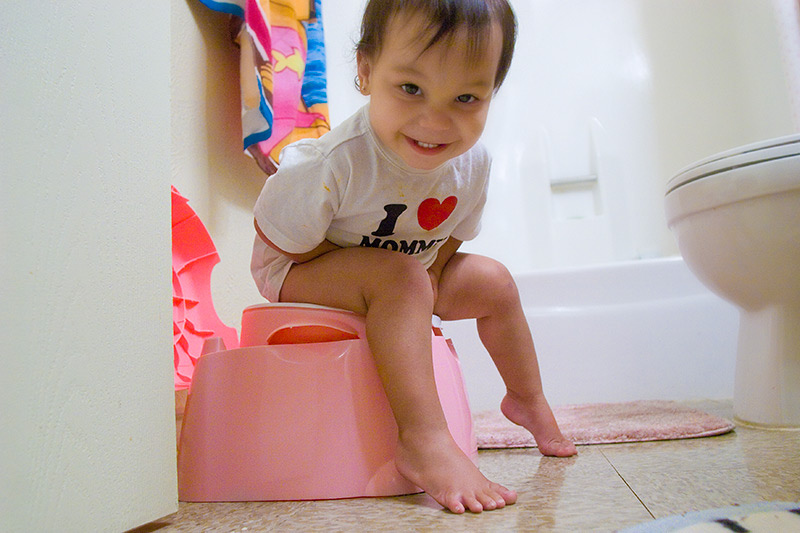
bathroom. Have her finish urinating on the toilet. Reinforce your child for urinating on the toilet. Reinforce her even if only a little went into the toilet. It’s OK to use the really good rewards for this partial urination on the toilet, in the beginning. You want your child to enjoy the reward. And to connect the reward with the act of urination on the toilet.
What to Do if You are Unable to Catch it in Time for Partial Success
If your child has a complete accident which you don’t see until it’s finished, remain calm. Don’t react. Don’t talk about the accident. Just bring your child to the bathroom to clean up. Act as if nothing has happened. Stay as neutral as you can. Stay close to your child throughout the training sessions. Try to watch her closely. That will help you catch any accidents as early as you can. The more closely you watch your child, the fewer and smaller the accidents should be.
Continue to Reinforce Partial Success but Save your Best Rewards for the Bullseye!
Continue to reinforce even partial urination on the toilet. Use your child’s favorite reinforcers until she has her first success at beginning to pee while already sitting on the toilet. When that happens, give your child an even bigger amount of her favorite reinforcer. After the first time this happens, reward partial success a little differently. What if your child begins to pee when she is not on the toilet, but you get to the bathroom in time for some of it to go into the toilet? Praise your child and give her a small reward. It should still be something she likes. Otherwise, it wouldn’t be a reward! But save your best and biggest rewards for when your child holds her urine until she is sitting on the toilet.
| So, let’s repeat that: When your child is learning that urine goes in the toilet, give her a big reinforcer for just finishing urinating in the toilet. After your child has had a complete urination in the toilet at least once, continue reinforcing even just a few drops or finishing urinating in the toilet using a slightly less preferred reward or a smaller amount of a favorite reward. From then on, you will save your bigger or favorite reinforcer for when she gets all of the urine in the toilet. |
Here’s an example. Say you are using Skittles as your special reward for toilet training. In the beginning you could give her 3 or 4 Skittles for finishing her urination in the toilet. Save Skittles only for toilet training. The very first time your child pees in the toilet from start to finish, you could give her 8 or 10 Skittles or even a whole “mini snack bag” of Skittles. After that, any time that she begins to pee in her underwear and only finishes in the toilet, give 1 or 2 Skittles for the partial urination in the toilet. Then, give more Skittles (5-8) when she holds her urine until she is sitting on the toilet and does her whole urination into the toilet.
Here’s an example of what you could use if your child happens to like Skittles or another similarly small sized treat:
After your child has had a few complete urinations in the toilet:
|
Continue to give your child a good amount (in our example, 5-8 Skittles) of a favorite treat whenever she successfully pees on the toilet from start to finish. This will keep her motivation up. You may need to do this for weeks, or even months. Be careful not to give TOO much of the treat at one time. Remember, children pee several times a day. You don’t want your child to become bored with the treats. Use enough to make it a special treat, but not so much that it isn’t special anymore.
When to Stop Giving Treats for Partial Success
Once your child is starting to pee while sitting on the toilet more often than in her underwear, that’s a big milestone. You can stop giving an edible or other very special treat for a partial urination in the toilet. You should say something like, “Good try! But next time, let’s get it ALL in the potty. Then you can have some Skittles!”
Increasing the Time Between Scheduled Sittings
Each time your child pees on the toilet from start to finish during one of her timed sittings, you should deliver your most powerful reinforcer! This could be a big piece of her very favorite candy bar, or a good amount (10-12) of Skittles. Give her lots of praise. Make sure she knows that you are very happy that she has peed in the toilet.
Then increase the time between the scheduled sittings by 10 minutes. For example, after the first time your child pees entirely on the toilet, increase the time from 10 minutes to 20 minutes between sittings. Still have your child sit for only 3-5 minutes each time. Continue increasing the time between sittings by 10 minutes after each success. Do this until you are up to 30 minutes between sittings. Remember to only increase the time between sittings if your child succeeds in urinating in the toilet from start to finish. Do not increase the time between sittings if your child starts to pee before sitting on the toilet. Do not increase the time even if most of it went into the toilet.
For example, let’s say that during your child’s first training session, she has one success. That is, she pees on the toilet from start to finish. In that case, you would move from 10 minutes to 20 minutes between sittings. But let’s say that before the next 20 minutes was finished, she started to pee before she sat on the toilet. In that case, you would stay at 20 minutes between sittings. You would start off your next training session by bringing her to the toilet every 20 minutes. Continue on a 20-minute schedule until the next success. Then, you would add another 10 minutes, bringing you up to 30 minutes.
What to do When Your Child is up to 30 Minutes Between Scheduled Sittings
At this point, you will increase the time between sittings more slowly. From this point on, increase the time between sittings by 10 minutes only if your child remains dry for two hours in a row. This means your child has no accidents for 2 hours when prompted to sit on the toilet only once every 30 minutes.
Each time this happens, increase the time between prompts by 10 minutes. When she stays dry for 2 hours when prompted every 30 minutes, increase the time to 40 minutes. Don’t increase the time between sittings to 50 minutes until your child stays dry for at least 2 hours on a 40-minute schedule. Remember, this might be days or weeks or even months into toilet training.
What to do When Your Child Reaches 60 Minutes (1 Hour) Between Scheduled Sittings
Once you reach 1 hour in between scheduled practice sittings, you should continue to do the sittings once an hour. Do this all day, until your child is dry most of the time. Once she is wearing underpants and has NO ACCIDENTS for a period of at least one week, increase the time between reminders by 30 minutes. At this point you are reminding her no more frequently than 1 time every 1.5 hours. When your child has had no accidents for another full week you should increase the time between reminders to sit by another 30 minutes. This will bring you to 2 hours between sittings. Once your child has NO ACCIDENTS for at least one full week with reminders no more frequently than once every 2 hours, you should be ready to begin Part 2 of Daytime Urine Training. Let’s review some key points.
Gradually Increase the Time Between Scheduled Practice Sittings – Outline
|
Condition |
Increase Time Between Sittings |
Total Time Between Sittings |
| Complete Accidents or Partial Successes only | (Do not increase time between sittings.) | 10 minutes |
| First Complete Success | Increase by 10 Minutes | 20 Minutes |
| Second Complete Success | Increase by 10 Minutes | 30 Minutes |
| Child is Dry Throughout a 2-Hour Training Session and Urinates on the Toilet at Least Once | Increase by 10 Minutes | 40 Minutes |
| Child is Dry Throughout another 2-Hour Training Session and Urinates on the Toilet at Least Once | Increase by 10 Minutes | 50 minutes |
| Child is Dry Throughout another 2-Hour Training Session | Increase by 10 Minutes | 60 Minutes (1 Hour) |
| Child has no accidents for at least one week, when reminded only one time per hour. | No Reminders for an additional 30 minutes | 1 Hour & 30 Minutes |
| Child has no accidents for at least one week, when reminded only one time per hour-and-a-half during training sessions. | No Reminders for an additional 30 minutes | 2 Hours |
Be Sure to Reinforce Your Child for Initiating the Use of the Toilet on Her Own!
Your child will probably not initiate using the toilet on her own during the first few training sessions. But, if at any point your child requests the toilet, or uses the toilet all by herself, throw a party! Do this even if she pees only a tiny bit. Whatever your child loves most, be sure that she gets it and right away!
If your child doesn’t initiate on her own, just continue to prompt her to say “toilet” or “potty” or “I want potty”. If she does not yet speak, prompt her to ask for the toilet by handing you the picture of the toilet. Then praise her for doing so, and maybe even give her a little treat, just for asking for the potty. This is in addition to the treat(s) she gets for urinating on the toilet.
How Long Your Training Sessions Should Last
Try to continue with your first toilet training session for about four (4) hours before a break. When you finish, go ahead and put a diaper or pull-up on your child and go back to your usual schedule. And, if your child initiates using the toilet while wearing a diaper or pull-up, reinforce this with great enthusiasm!
If it’s possible to do a second four-hour training session on the same day, that would be a good idea. If you can only fit in a shorter session, that’s still ok. Try for at least two hours. The longer, the better.
Do this intensive training for two or three days in a row. We understand that may be hard. After that, you should try to fit in as many training sessions each day as you can. After the first days of intensive training, training sessions can be as short as 2 hours.
Part 1 of Daytime Urine Training has two goals. The first is for your child to learn that urine goes in the toilet. It’s also important for your child to practice this with lots of good rewards. The second is to stay dry in between practice sittings. The time between practice sittings is increased gradually. You want her to stay dry for 2 hours at a time without prompts or reminders to use the toilet.
- Goal #1: Learn that urine goes in the toilet. Get lots of practice with good rewards.
- Goal #2: Stay dry for 2 hours at a time without reminders.
Also, you want your child to begin to initiate on her own. If your child doesn’t begin to initiate on her own, don’t worry. Just continue to prompt her to request the toilet just before heading into the bathroom for each practice sitting. We will talk more about getting your child to initiate using the toilet in Daytime Urine Training Part 2.
Underpants Versus Diapers
Once your child remains dry for two training hours in a row, at least twice, and is successfully peeing in the toilet, it is time for cotton underpants! Many stores sell “training pants” which are just extra thick cotton underpants for young children.

freepik
These are especially good. But any cotton underpants will work. Many stores sell children’s underpants with fun designs. It might be fun for your child to pick out a design that she likes, like animals, or favorite story characters.
Many parents find that once their child is ready for underpants, it is not hard to keep the training sessions going throughout the day. Then change your child back into a diaper or pull-up only at bedtime.
When you do the training all day, you should set a timer as a reminder to bring your child to the toilet on her schedule. This could be every 30, 40, 50, or 60 minutes, whatever time interval your child has reached. Remember to prompt your child to ask for the toilet. Then your child should sit on the toilet for 3 to 5 minutes before you remove her from the toilet, reset the timer, and begin again.

Toilet training tends to go MUCH better when children wear underpants throughout the day instead of diapers or pull-ups. Most diapers are designed to absorb the urine and keep your child as dry and as comfortable as possible. With underpants, however, if your child has an accident she can feel the cold, wet cotton. Many children do not like this feeling. Having this feeling right after an accident can help to speed up the training process. It motivates children to try to hold their urine until they reach the toilet.