

Sorting by Category
Now we will discuss how to teach your child to sort objects into groups or categories of similar things. Then, we will discuss how to teach your child to understand the names of common categories. This skill is important for the development of thinking skills. Imagine trying to describe or explain things without knowing that an apple and an orange are both “fruit” or “food.” Understanding these more general words is important.
Things Your Child Should Know Before You Teach Category Sorting
Before starting this teaching program, your child should have mastered several skills. Don’t start this until your child can successfully match non-identical pictures. Examples of non-identical matching might be matching different pictures of apples or matching different types of shoes or cars. Your child should have learned at least 6 receptive labels from each of 3 categories, such as 6 clothing items, 6 foods, and 6 animals. He should also be able to identify multiple pictures of each of these things. You can also re-use pictures from the previous sections of this module.
The Most Common Categories
Here is a list of nine common categories:
- Food (Includes Drinks)
- Animals
- Clothing (Includes Footwear)
- Furniture
- Vehicles
- Body Parts
- Colors
- Shapes
- Appliances (Refrigerator, Stove, etc)
When children have learned to sort by category, they can group pictures of an apple, cookie, and yogurt together and know they are all “food.” Or they can group pictures of a car, truck and train together and know they are all vehicles. We suggest starting with three of these categories. Food and clothing are good choices because children see them every day. Choose a third category based on your child’s interests and the words he has learned so far. Animals and vehicles for example, are common categories children learn early on.
Once your child has mastered the common categories, you can introduce more categories based on the child’s experience and interests. Examples include musical instruments, numbers, letters, rooms, tools, utensils, jewelry, etc. For example, if your child doesn’t know any numbers or letters yet, it wouldn’t be helpful to teach those categories. However, if they have a strong interest in music and know the names of some musical instruments, teaching “musical instruments” as a category would make sense.
Sorting by Category Teaching Program
Begin with a set of 6 items from each of three categories you chose. These should be things that you child is familiar with.
Here is a sample starter set of items in three categories:
| Food | Animals | Clothing |
| Apple | Dog | Sock |
| Cheerios | Cat | Shirt |
| Cookie | Cow | Shoes |
| Bread | Horse | Pants |
| Yogurt | Pig | Shorts |
| Banana | Elephant | Coat |
Place three pieces of colored paper, clear plastic bins, or paper plates on the table. Create separate spaces for three groups of cards. Put 2-3 pictures from a single category in each space.
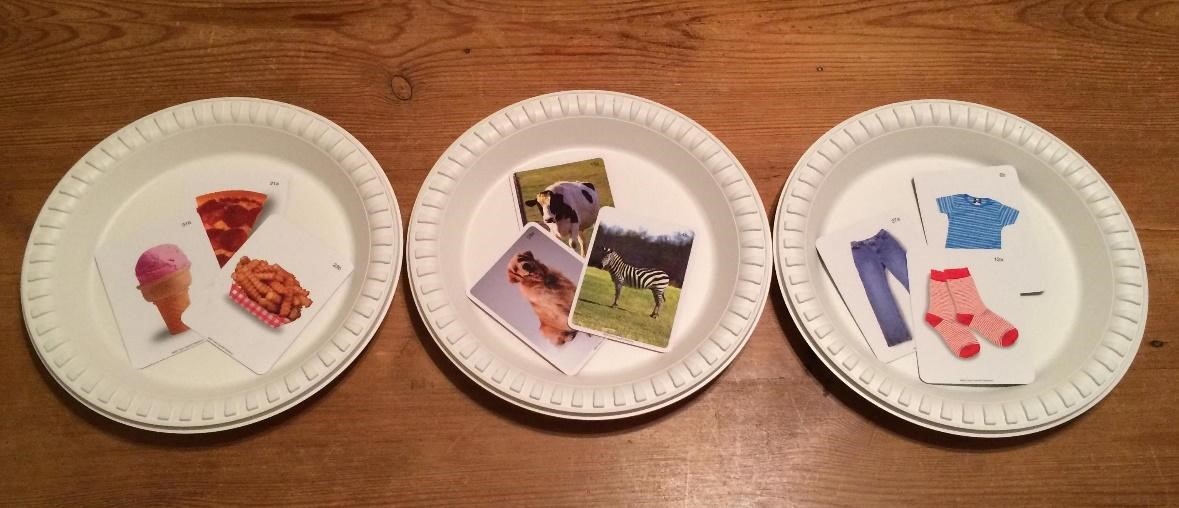
Give your child a picture and ask him to put it into the correct group using both the name of the item and the category. For example, say, “Put the dog with the animals,” “Put dog with animals,” or “Dog is an animal.” Prompt as needed for your child to place the picture in the right group.
- Place three paper plates on the table in front of your child. Put two to three pictures from a single category in each space.
- Hand your child a picture of an item that belongs with one of the groups of pictures on the table.
- Give a clear and simple instruction. For example, “Put apple with food.”
- Use a prompt you think will work. You will use smaller prompts over time.
- Reinforce your child for placing the picture you have handed him with the other pictures from the same category.
Remember to present the trials randomly and change the locations of the categories on the table each time. Gradually fade prompts until your child can sort without help.
Test for Generalization of Category Sorting
Once your child can sort the items you picked into the correct groups, you can test to see if he understands the idea. Add new pictures to each category and see if your child places them with the others in the correct category. For example, if your child has learned to group pictures of Cheerios, apple, cookie, bread, yogurt and milk together, you could try a picture of a banana or a piece of cheese. This is to see if he has really grasped the concept of “food” as a category.
Maintaining the Mastered Categories and Adding New Ones
If your child can sort new items into all the categories he has learned without prompts, you can add a new category. Present it along with two mastered categories in a random order.
You will probably need to prompt items from the new category, but your child should be able to sort items from the already mastered categories. And he should do so without prompts. Try to present pictures of items from the new category about 4 times out of every 10 trials. Leave the rest of the trials for practicing with the categories he has already learned. Remember, maintenance of things your child has already learned, through continued practice, is very important. You should only need to keep track of how well your child is doing with the new category, because he should already know the others.
Remember, maintenance of things your child has already learned, through continued practice, is very important.
Keep adding one category at a time. Ensure your child practices the previously mastered categories. To give him enough practice, teach your child to sort pictures from mastered categories on his own. Put three paper plates or pieces of paper on the table with pictures from different categories and ask your child to sort them. Once he learns this, he should practice it once or twice a day.
If your child has difficulty or doesn’t understand the task, stand behind him and guide his hand to sort one picture at a time. You can quickly fade prompts since your child already understands the general idea of sorting by category. You’re simply teaching him to pick up pictures by himself instead of you handing him the pictures one at a time.