

A Few More Words About Eye Contact…
Often children who can ask for things with words don’t point to them. They also don’t make clear eye contact when asking for the things they want. This is especially true of children on the autism spectrum. If this is true of your child, you may be asking, “Is it important to teach him to point and look at me when he is already asking for things with words?”
That’s a really good question. The short answer is, yes, you should still teach your child to point and to look at you. Some of the children in the videos have words to get what they want, but they’re still being taught to point and look. Let’s talk first about why it’s important for children to learn to make clear eye contact with people. We’ll get back to pointing in a few minutes.
Here are three reasons why eye contact is so important:
|
As we have said, it can be hard to get some children to make eye contact with you, but it’s important to try. It’s important for your child to learn to look at your face and your eyes as much as possible. One of the reasons we start teaching eye contact while teaching requesting is because when your child wants something, he may be more likely to pay attention to you. If your child makes eye contact with you each time he makes a request and is then rewarded right away by getting the thing he asked for, this will make him more likely to make eye contact with you in the future.
When your child just happens to look at you, make sure to reward that behavior. You can do that with words, for example, you could say something like, “Your eyes are smiling at me!” Or, you can simply respond with a smile, or by making a silly face, or with a game, like peek-a-boo.
See how much this baby is enjoying the surprise! Before the teacher started the peek-a-boo game she had to work hard to get any eye contact with the child. But after the first surprise, the child was responding to eye contact with big smiles and even giggles.
How long should your child look at you to consider it “real eye contact” Different cultures treat eye contact in different ways. Comfortable eye contact can vary from 2 to 10 seconds, in different cultures. Go with a length of time you feel is comfortable. But remember – even very short eye contact is better then avoiding looking at your eyes – you can work on getting the eye contact longer, but “fleeting” eye contact is better than none! For some children, making eye contact with others is uncomfortable; in this case, you can accept a shorter eye contact than you might for another child.
There are other good ways to work on eye contact. These ideas can work for children of all ages. Many of these ideas can work even with very young children or those who do not talk yet.
Increasing Eye-Contact by Making Yourself a Part of Fun Activities
One very good way of teaching your child to make clearer eye contact is to put yourself into your child’s favorite fun activities. You can make eye contact an on and off switch for the fun. For example, if your child likes music, you can sing a song that she likes, and then stop, and wait for eye contact before you start singing again. The next two video clips will show this.
The best activities for working on eye contact are ones that the child needs your help with. This could include turning on music, blowing up a balloon, swinging on a swing, blowing bubbles, or spinning tops. In the next clips, watch how the teachers wait for the child’s eye contact before continuing the fun. Watch how they sometimes hold the toys near their own eyes to prompt the child to look at them. You might also notice that they tend to use very simple language. They are working on teaching a word or two while reinforcing eye contact. Most important of all, they are keeping the child engaged and building a joyful connection with the adult.
This is really quite simple once you get the hang of it. Make sure you have an activity that your child can’t do by himself and needs you to do with him. The most important thing you can teach your child is that interactions with other people, especially you, are fun, rewarding and joyful.

Of course, not ALL toys are good for working on eye contact and social interaction. Some toys actually work against interacting with others. These would include toys that the child can enjoy playing with all by himself. Toys that fascinate the child may also discourage eye contact. Things like iPads, for example, can be very hard to compete with! And even if you are gentle as you try to remove the iPad and switch to a different toy, your child may become upset when you do so. It’s always best to offer another toy before removing the one that is holding the child’s attention.
In the next clip, watch how the teacher covers the iPad with the child’s favorite puzzle before taking the iPad away. The little boy does get out of his seat and tries to get to the iPad. However, when he sees that the iPad cover is closed, and the pieces of his favorite puzzle are ready to play with, he reaches for the puzzle. Then, she easily gets him back into the chair. And now he is playing with a toy they can play with together.
In the next clip, the child had been playing with a toy piano. The teacher tried to join in the play by singing the notes as she pressed the keys. But she was having a hard time getting the child’s attention. Working on eye contact and social interaction was the main goal during this play session. So, the teacher decided to replace that toy with one she thought would work better.
Notice that here too, the teacher handed the child the puzzle, before taking away the piano. You might also have seen that she removed the puzzle pieces before handing the child the puzzle board. After taking away her little piano, the teacher didn’t want to give her a puzzle and then take the puzzle pieces away too!
There are so many activities you can do with your child to help him to look at you more. All of these activities involve having fun together. If your child is small enough for you to pick him up and swing him around, he may like that a lot. Just remember to wait until he’s made eye contact with you before each spin. If your child tends to reach his arms up to you when he wants to be picked up, bend down to pick him up as you would normally do. However, wait for a few seconds with your hands on his sides until he makes eye contact before you actually lift him off of the ground.
A great activity for working on eye contact is standing in front of a child and pushing him on a swing. In the next clip, watch how the teacher stops the swing and waits for eye contact before giving the child another push. As long as he is making clear eye contact, the swinging continues. In this way, eye contact is like the on and off switch for the fun!
You don’t need to do a lot of new activities to work on eye contact. You can just do the things your child already likes. The main difference is really about timing. You want to wait until you get eye contact and then immediately start another round of the fun.
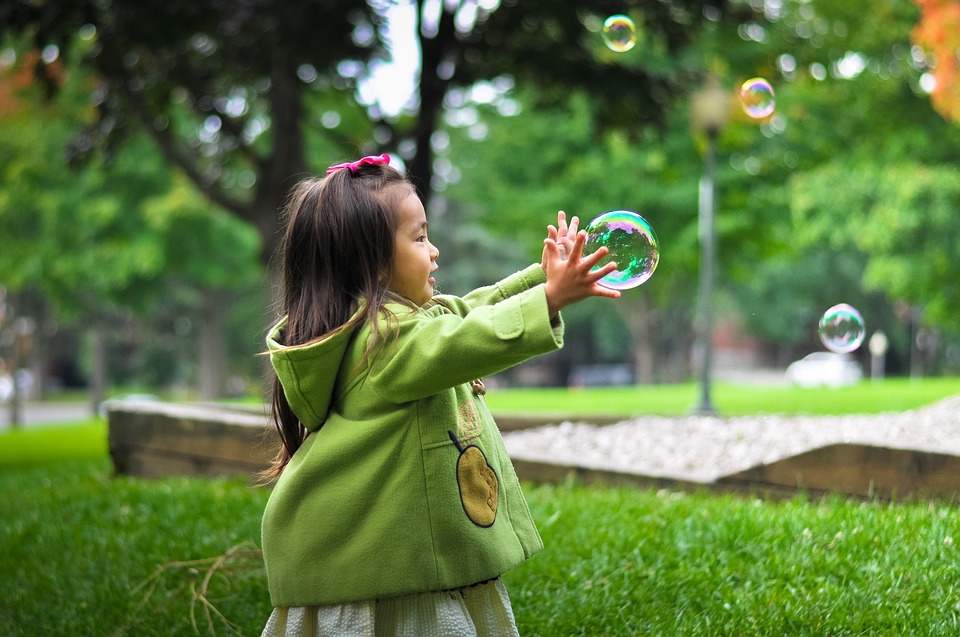
Playing with bubbles is another great way to work on eye contact. In the next clip, the teacher waits for eye contact before blowing the bubbles. Notice how she prompts eye contact by putting the bubble wand close to her eyes. Watch carefully for the timing…first eye contact, then bubbles!
Many simple toys are excellent for working on eye contact.
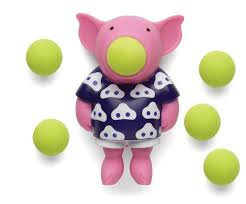
This clip shows an example using this Pig Popper toy. See how the teacher waits for the little boy’s eye contact. Then she makes the little ball pop out of the pig’s nose and shoot across the room. At first, it takes a little longer for him to look at her when she’s getting ready to pop the ball. But he learns pretty quickly that looking into her eyes is the “on switch” for the fun. And because he doesn’t know how to shoot the ball himself, he wants to interact with the teacher using this toy.

And here’s another way to work on eye contact using a balloon. Notice how the teacher waits for eye contact before she blows air into the balloon. Making eye contact is being reinforced by seeing the balloon get bigger and by watching it fly. And notice too how the teacher uses very simple language so that he can listen to only the most important words. For example, she says the word “bigger” each time she blows air into the balloon. Since she doesn’t use a lot of other words, she is increasing the chance that he will start to understand what “bigger” means. And just before she lets go of the balloon, she counts to three. She wants to build excitement and make it fun!
If you are still feeding your child some of the time, meals are a good time to work on eye contact. Just require eye contact for each spoonful or piece of food that you offer. Simply hold up a spoonful or a piece of food. As soon as your child makes eye contact, put the spoonful of food into his mouth. You can also use this as an opportunity to teach him the word for the food you are feeding him. Again, if you use very simple language, it will be easier for him to pair the word you are saying with food he is eating.
This teacher prompted eye contact by holding the spoon very close to her own eyes. When a child is hungry, food will be a powerful reward, so meals can be a good time to teach. But remember – don’t ever let your child go hungry or without the good nutrition he needs. You will have plenty of chances to teach the skills you want your child to learn. If your child is very hungry when the meal starts he may get very frustrated if you make him point or look at you to get food. So give your child some food as usual so he won’t be as hungry, before you start to ask for eye contact or pointing.
Teaching Your Child to Make Eye Contact When He Hears his Name
Responding to one’s name is an important skill. Your child should learn to acknowledge another person’s attempt to solicit his attention. Once your child seems comfortable making eye contact with you, we suggest teaching him to respond to his own name. You can practice this several times in a row, many times throughout the day. Start by holding a preferred treat or a small toy in your hand and say your child’s name.
For example, say “Anna?” If she looks at you right away, immediately offer her the preferred item in your hand. Do this by holding the treat in front of her and giving it to her.
If your child does not make eye contact but tries to take the treat from your hand, simply hold onto the treat until he looks at you and then give it to him immediately. If you need to, you can use the item to get him to look into your eyes.
Do this by holding it in front of him and then once he looks at it, move it toward your own eyes. Once he makes eye contact, give him a big smile while quickly giving him the item he wants.

You should practice this in a variety of rooms in your home, outdoors and out in the community. And try to use natural reinforcers as often as you can. For example, if your child is making a puzzle that he enjoys, quietly take a puzzle piece, and put it in your pocket. Then call his name and as soon as he looks at you, offer him the puzzle piece. Or, if he is playing with toy cars or with a ball track toy, quietly remove a couple of cars or balls and then use them to reinforce him for looking at you when you call his name.
Your child may need to practice this skill with several family members before he really has learned it. Once your child is looking at you most of the time when you call his name, you can begin to call h is without offering him a reinforcer. Call his name to show him things he might find interesting or to compliment him on something that he is doing or something that he has just done. Or you can call his name just to tell him that you love him. Gradually, lower the percentage of times you call his name to offer a treat. As you do this, gradually increase the percentage of times you call his name to tell him things.
Once in a while, you can begin to call his name for the purpose of asking him to do something. For example, you might say, “Anna?” Then when he looks at you, you could ask him to bring you something, to give you a hug, or to put a toy away. You may need to use gestures to help him understand what you are asking of him. For example, if you want him to put a block in the block bin, you could hand him a block while pointing with your other hand to the bin of blocks. Once he has looked at you and is reaching for the block you could say something like, “Put it in.”
Just be careful not to call his name mostly for the purpose of putting demands on him. This could result in decreasing the chances that your child will look at you when you call his name. When you do call his name for the purpose of asking a question or giving an instruction, make sure to reinforce his response to the question or instruction. A wink, a smile, a pat on the head, a tickle and/or a thank you, can go a long way.
Even after your child often responds to his own name with eye contact, you may still need to teach him that his name refers to him in the way that other people’s names refer to them. However, don’t worry about that just yet. We will talk about this much later in Module 11- Understanding Language.
One final note; every country and every culture has customs about eye contact. In some countries, people make eye contact with each other for longer periods than in other countries. Try to get your child to make eye contact with you for as long as seems natural to you but not longer than that.