
Games For Chores And Cleanup
Almost any chore can be used to teach language and communication skills, matching and sorting, and even pretend play. Let’s begin with laundry.
1. DRIVING TO THE WASHING MACHINE: FAST, SLOW, STOP & GO
You can do this at home or in a laundromat, as long as the laundromat is not too busy or noisy. You can pretend your laundry basket is a boat or car that your child can “drive.” Give her a round toy, like a Frisbee or a plastic ring or plate, that she can use as a steering wheel, and help her “drive” the laundry basket.
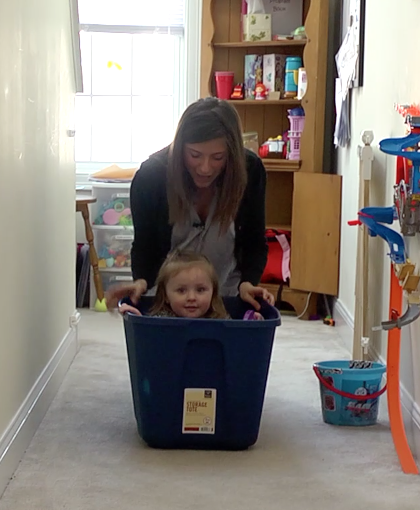
You can work on “fast” and “slow” and “stop” and “go” by putting your child on top of the clothes in the laundry basket and pushing the laundry basket to and from the washing machine at different speeds. Then wait for your child to communicate with you. You can say, “fast, fast, fast” while pushing the basket fast, and then, “slooooowwww” while pushing it very slowly. Then ask her if she if she wants to go “fast” or “slow” and if she can’t say these words, you can ask, “Do you want fast?” and help her nod ‘yes’ by modeling (demonstrating) it so that she can imitate you.
Then you can do the same thing with “stop” and “go.” Stop and go as you move about on your way to the washing machine. When you stop, wait for your child to communicate with you before pushing the basket again. If your child is not talking yet she may simply rock her body to try to communicate “go.” This should be rewarded, especially if she is looking at you. You can make it easier for her to look at you by stooping down to her level and pulling the basket instead of pushing it. That way, you will be face to face with your child. And if your child loves trains, give her a ride in a Laundry Basket Train with her as the conductor. All Aboard!
2. THE LAUNDRY ROUTINE TO WORK ON EYE CONTACT AND WORKING WITH ANOTHER PERSON
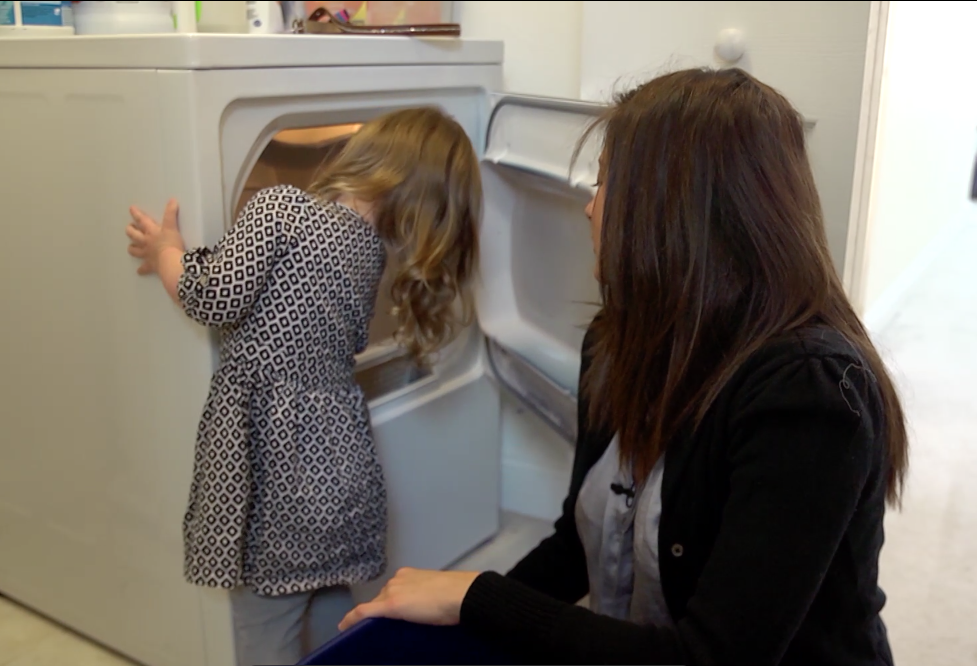
When you are ready to put the clothes into the washing machine, you can have your child hand you the pieces of clothing, one at a time, and then you can put them into the machine. If your child can reach the opening of the machine, you could hand her the clothes and have her toss them in, which might be more fun. Make sure you have eye contact before passing each item of clothing to and from one another. If your child enjoys throwing the clothes into the machine, then putting each item into her hand is a natural reward for eye contact. Learning to work with another person is a very important skill to learn.
Depending upon your child’s language level you can use this activity to work on things like big and little, colors, clothing words such as shirt, pants, dress, and so on. You can also work on pronouns, like “my” and “your.”
3. “LAUNDRY LANGUAGE” ROUTINES TO WORK ON THE WORDS FOR CLOTHING, COLORS, “WET” AND “DRY,” AND THE IDEA OF POSSESSION
Having your child help you with the laundry can provide a great way to work on language too. Label each piece of clothing…”shirt,” “pants,” “socks” and so on, as you hand it to your child to put into the washing machine or dryer. Or, if your child is ready for two words, you could label the articles of clothing and add a color word, like “blue shirt” or “white sock.” You can even work on the names of family members and the idea of possession by saying the name of the family member whose clothing you are holding as you hand over each piece. For example, you could say, “Mommy’s shirt” or “Baby’s sock.” For an older child with more language, you can ask, “Whose socks are these?” or “What color is this shirt?” And you can do similar routines when putting the wet clothes into the dryer and when folding the clothes once they are dry. You can even work on the words “wet” and “dry” by labeling the items as “wet” as you place each piece into the dryer and later, labeling those same pieces of clothing as “dry” when you remove them from the dryer.
4. LAUNDRY MATCHING ROUTINES TO WORK ON MATCHING, SORTING, AND THE WORDS “BIG” AND “LITTLE”
When you take the laundry out, help your child sort her clothes from the grown-ups, or try to make “matches” with socks or underwear. This will help her to develop the idea of sorting and matching, as well as big and little. For example, take one of your socks and hold it up next to one of hers. Say, “This is one is big. It’s Mommy’s sock, and this one is little. It’s baby’s sock.”
As you take the dirty clothes out of the laundry basket, hold up two different articles of clothing, a shirt and a sock, for example. Say, “Throw the sock in!” or “Which one is the sock?” When she reaches for, or points to the correct item, cheer for her, then hand it to her and let her throw it in. If she reaches for the incorrect item, just hold both items out of her reach and try again, but the second time, prompt her by holding the sock a bit closer to her and the shirt a bit further away.
5. THE CLEAN UP SONG AND CLEAN UP SORTING TO WORK ON SORTING THINGS THAT BELONG TOGETHER
Getting children to help with cleaning up can be a real challenge for any parent. Start with just one toy that has to go in a basket or on a shelf. You can sing the “Clean-up song” that is often sung in preschools (“Clean up, clean up, everybody everywhere, clean up, clean up, everybody do their share”) – or any of the many clean up songs on the internet – any one that you like.
This may be your child’s first chance to start learning how to sort things or how to put similar things together. Clean up time is a great place to work on that skill, especially if you take a little time to organize your child’s toys and books ahead of time. That way, you can begin by showing your child that everything has a special place or belongs somewhere. For example, if you have an area on a shelf or a small bin to hold your child’s books, another container for her puzzles, another for her blocks, and one more for her cars and trains, you can show her that books go in one place and blocks go somewhere else.
It helps if you can label the bins or boxes by taking a picture of each one, filled with the toys that belong inside, and then attach the pictures to the bins. You can sing “The Clean Up Song” and then pick up a book and say, “It’s clean up time! This is a book.” Then point to your child’s bin of books and say, “Books go here,” and prompt her to put the book in the bin with the other books. Then of course, praise her enthusiastically and show her how happy you are that she is such a big girl cleaning up her toys! Begin with only a few items at a time, gradually increasing the number of items you ask your child to put away.
If your child can say some words, you can hold up a toy, for example a puzzle, and ask, “What’s this?” If she doesn’t answer, you can prompt her by saying “It’s a pu….” or answer for her (“It’s a puzzle.”) and then ask, “Where do puzzles go?” If she doesn’t start toward the right place guide her gently and point to the place the puzzle belongs, saying, “Puzzles go here! Good cleaning up!” Repeat this process again and again until your child starts to understand what goes where. If it gets boring, it might help to try making a game of it by saying, “Does a book go here?” And put it someplace silly, like on your head, and let your child correct you.
6. SORTING SILVERWARE
If your child is catching on to the idea of sorting, you can have her help when you put away clean silverware. Seat her at the table or in her high-chair and put the silverware tray in front of her. Put a few of the clean forks and spoons next to the silverware tray. Help her to put the forks with the other forks and the spoons with the other spoons. Of course, don’t give her knives to sort, and watch to make sure she doesn’t poke herself with a fork.