

Games For Bedtime
1. THE “UP” ROUTINE FOR LEARNING THE WORD “UP”
Waking in the morning or after a nap is a great time to practice the word “up.” When you walk in and see your child standing in her crib, give her a warm smile to show how happy you are to see her. Then reach out your arms and say, “Up?!” in a happy, questioning, or rising tone of voice. If she doesn’t raise her arms, then use a physical prompt to help her raise her arms in a movement that means “Pick me up” or “I want up.” Make sure you have her eye contact just before you lift her out of the crib. Then immediately pick her up and give her a warm hug. Do this often when she wakes in the morning as well as when she wakes from her naps. Before long, she should be raising her arms on her own and looking right at you when she wants to get out of her crib. If she is able to imitate sounds or words, you can also try to work on having her say the word “up” just before you pick her up.
2. GOODNIGHT ROUTINE FOR LEARNING THE NAMES OF FAVORITE TOYS AND PEOPLE

Bedtime routines are a good idea for all children. Consistent, nightly routines can help children wind down and make bedtime feel safe and comforting. Here are some ideas to include in your child’s bedtime routine.
Have your child give goodnight kisses or hugs to any of her family members before she goes to bed. Make up a routine for saying goodnight at bedtime using each person’s name twice. For example, kiss all family members and stuffed animals good night saying “kiss brother, goodnight brother, kiss Daddy, goodnight Daddy” and so on. When you get to where your child’s bed is, keep it going by walking around the room and stopping in front of your child’s favorite stuffed animals or toys to give them goodnight kisses. And she can collect a few stuffed animals along the way to bring with her into the bed. If you do that, have her kiss the stuffed animals good night, but be sure to take them out of her crib before she goes to sleep. Experts think that soft things like stuffed animals and blankets might block the baby’s breathing, especially before her second birthday.
3. THE JELLY ROLL GAME FOR WORKING ON SOCIAL INTERACTION
Another activity that many children like a lot is when a parent wraps them up in a blanket like a jelly roll and then pretends to eat them. Of course, you always want to make sure that your child’s head and face are not covered by the blanket so that she can breathe freely!
Another way to make a game with a blanket is by bringing a blanket to your child, having her sit on it on the floor, and pulling the blanket, and her with it, around the room. You can stop a few times and prompt her to say “go” or to make a sign for go before pulling her some more.
Then when you get to the bed, tell her you are going to make a sweet jelly roll, using her name in place of the word jelly. For example, you could say, “I’m going to make a sweet, sweet, Sarah Roll and I’m going to eat it ALL UP!” As you say this, wrap her up in the blanket and then pretend you are going to eat her up, making all sorts of chomping noises and saying “Mmmmm! Delicious!” She’ll love it!
At the end of the game, you can pick your child up, wrapped in the blanket, and carry her into her bedroom where you and your child can continue the bedtime routine, with a bedtime story. By saving this little game only for naptime and bedtime, the child should begin to look forward to the bedtime routine, and not try to avoid going to sleep, as many children do.
4. BEDTIME AND NAPTIME STORIES FOR WORKING ON LANGUAGE
When you read to your child or look at picture books with her, remember to sit in a position that allows you to make eye contact with your child before you turn each page. In fact, when you finish reading a page or pointing to a picture or two, pause and wait for eye contact before turning to the next page. In this way, seeing the picture on the next page is the reinforcer for eye contact.
It’s also a good idea to pause for a few seconds and wait for eye contact before commenting on pictures your child points to or looks at with interest. These are good ways to help your child practice shifting her gaze between you and something interesting.
When two people share an experience together like this, it is sometimes called joint attention. Your child might enjoy the job of turning the pages too. This is one more way to keep her actively engaged in the process. Just remember to rest your hand lightly on the page, letting it go only after she looks at you!
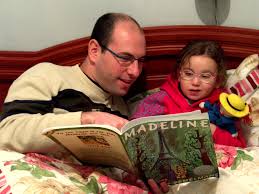
Reading bedtime stories each night is a wonderful routine for any child. Most books work fine as naptime stories too. There are many good things about this routine. If your child enjoys this time with you, when you are snuggled up together reading her favorite stories, it will help her enjoy bedtime, or naptime. That way, she might not try to avoid going to sleep. And she will be able to go to sleep feeling calm and safe.
For children who find it hard to learn language, it’s a good idea to choose just a few books at a time. You might want to choose books that use a repetitive language approach to work on teaching new words. A repetitive language approach is where the book uses the same words or phrases over and over. You will find ideas for some of these books in the resource section of this program, for example, “Brown Bear, Brown Bear, What do you see?” If you read the same three or four books to your child over and over again for a while, and your child likes them, you can try pointing to a picture and pausing before you say the word to see if she will fill in the blanks with the missing words. If she does this, be sure to praise her and give her lots of hugs and kisses. If she doesn’t say the word, just say it yourself and continue with the story.
Story-time can also be a good time to look at books about emotions. For very young children with ASD or any young child with a language delay, it’s best to stay with very simple books that deal with basic emotions. For example, you can use picture books that depict children feeling happy, sad, angry, excited and scared. Other simple feeling states, like sleepy, hot and cold are also good words for children to learn. There are many good picture books that show photographs of young children expressing these emotions and feeling states. For example, I Calm Down (Yo Me Calmo) comes in Spanish, and Calm-Down Time (Momento para Calmarse) comes in a Spanish + English edition.
For older children, or children with stronger language skills, there are books that talk about how to manage our emotions and offer strategies for learning to be flexible when things don’t go as planned or as we would like them to go.
If your child has a lot of difficulty in calming down once upset, and has enough language to understand some simple self-calming strategies, you could try teaching her a few strategies (practicing calm breathing by pretending to blow about candles, squeezing a favorite stuffed animal, getting a hug from mom while getting her feelings acknowledged “I know you’re upset but we will have cookies at snack time”, looking through a favorite book) while staying very calm and speaking softly yourself. In order to work, you’ll need to do these things as your child is starting to get worked up, not after she’s already really upset. And they will work even better if you practice them as a game when your child is feeling fine and not upset.
If your child understands this level of language, you might ask “What did we do today?”, especially if you did something special. Don’t expect very young children to remember the events of the day, but you can relate, in very simple language, anything that was out of the ordinary. “We went to the zoo! We saw elephants! That was a lot of fun!” This might help your child think about events earlier in the day, and how they felt.
5. HOMEMADE BOOKS FOR LEARNING LANGUAGE
If your child likes books, try making your own books especially for her. You can make books to help her learn about herself and her world. Here are a few examples using the repetitive language approach. If you want to teach her the names of her favorite foods you could take pictures of those foods and make a book called, “What does baby eat?” To make it very easy to follow, it’s best to start with only one picture on each page.
For example, say you want to teach your child the names of the foods she likes best. You could make a book to help with this. Every other page could be a picture of your child with the words, “What does baby eat?” Use your child’s name instead of the word “baby.” Then on the opposite page would be a picture of one of her favorite foods, with the words, “Baby eats” and then the word for the food on that page. You can take your own pictures, and some of those could show your child eating the foods you want your child to learn about. Or, or you can download food pictures from the internet. So, for example, if your child’s name is Danielle, the book might read, “What does Danielle eat?” “Danielle eats bananas.” “What does Danielle eat?” “Danielle eats yogurt.” “What does Danielle eat?” “Danielle eats cereal.” “What does Danielle eat?” “Danielle eats ice cream.” “Yum!”
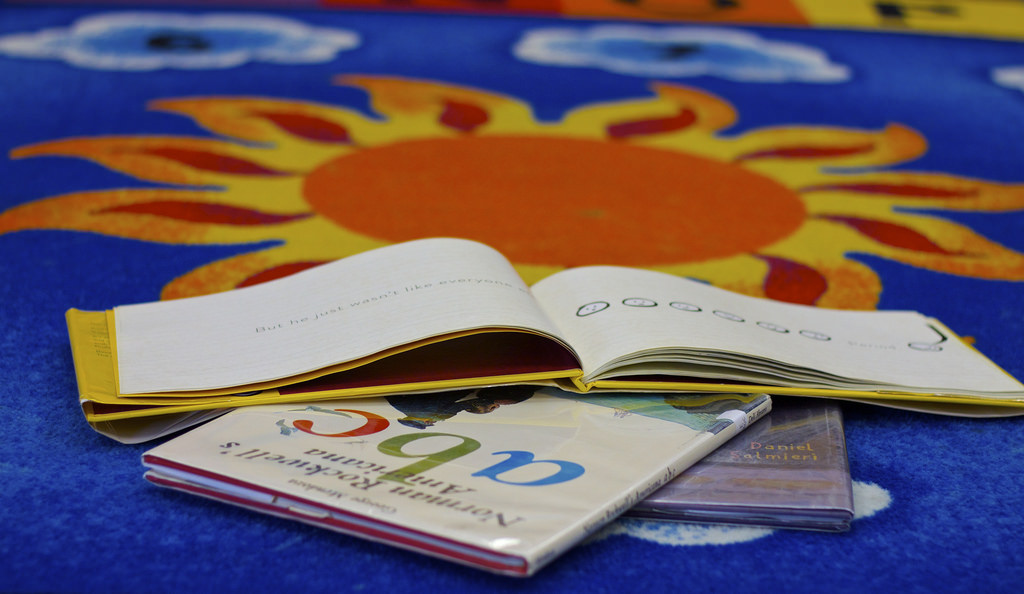
This homemade book would give you a great chance to work on the names of foods, the word “eat” and the child’s name. Once your child becomes familiar with the book, you could try pausing at some points to see if she says some of these words.
You could make a book called “What does baby wear?” This would help her learn the words for clothing. That book could have pictures of her in her pajamas, her swim suit, her coat, and so on. You could also make a book called, “Who loves Baby?” to help her learn the names of her family members.
If you want to begin teaching your child some action words, you could make a “What does baby do?” book. That book could have pictures of her eating, drinking, sliding, swinging, sleeping, bathing, reading and so on. You could even make an “All about baby” book that could have basic information about your child like her name, her age, the people in her family, and the things she loves. There are many, many books you could make! If your child does not like books, try first showing her interactive books that have flaps, pop-ups, or sound buttons. If there are characters she likes or things she loves, like fish, or trains, try books about those things.
In any case, keep the bedtime books happy and light. You always want your child to go to sleep thinking happy thoughts!
6. LULLABY AND GOODNIGHT FOR COMFORT AND MAKING CHOICES
Just before it’s finally time for your child to go to sleep, sing her a lullaby. Music is very soothing for bedtime. This is especially true if you sing the same set of songs every night. You might even make 3 pictures to go with 3 different lullabies like:
A “star” for Twinkle Twinkle Little Star,

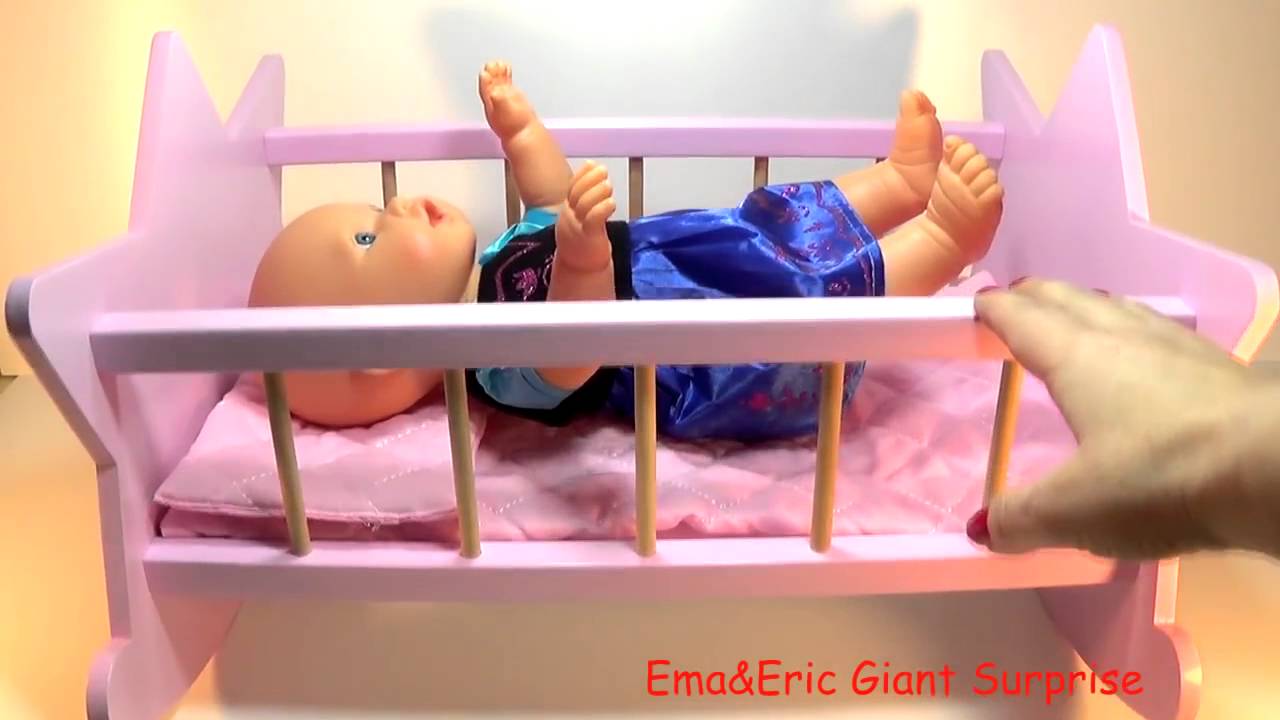
a “cradle with a baby” for Rock-a-Bye Baby,
and a “sun” for You Are My Sunshine.

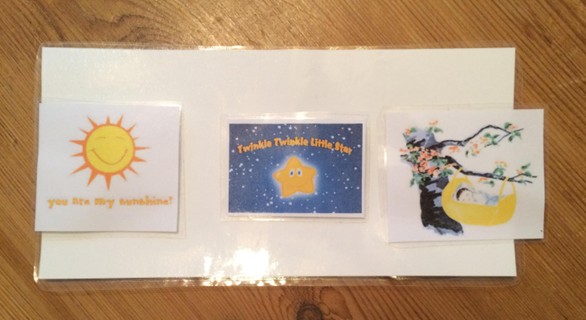
For example, here are three pictures for You Are My Sunshine, Twinkle Twinkle Little Star, and Rock a Bye Baby. You can point to the picture that goes with the song you’re about to sing. Once your child becomes familiar with the songs, you can try out the CLOZE (filling in) method to see if she will fill in some of the words. Start to sing the song and sing a few lines. Then, stop suddenly, just before a key word. For example, you could start singing “The Itsy Bitsy Spider” (or any song you know that has hand motions) using the hand motions. Then stop abruptly just before the word “sun.”
The itsy bitsy spider climbed up the water spout.
Out came the rain and washed the spider out.
Out came the _______(PAUSE)________
As you sing the line about the sun, raise your arms over your head, using the motion that goes with that line. Look at your child with an expectant look. Wait a few beats for her to say or sing the word “sun.” If she does, give her a BIG SMILE and quickly resume singing the song. Show her how happy you are that she has filled in the missing word. If she doesn’t fill in the word(s), no problem. Just resume your singing and try again on another key word.
After a while, you can ask your child which song she would like. She can answer by pointing to the picture that goes with the song she wants. If she doesn’t point after about 5 seconds, or isn’t paying much attention to the pictures, you could help her to point to one. You may have a hunch about which one she likes best. But if you think she likes them all about the same, just choose one and help her to point to it. Then sing the song she asked for. Singing that song will be a great, natural reinforcer for her having asked for it by pointing.
7. INVOLVE YOUR CHILD IN GETTING READY FOR TOOTH BRUSHING TO TEACH THE WORD “SQUEEZE” AND THE PHRASES “TURN ON” AND “TURN OFF”
Instead of getting everything ready for your child before brushing her teeth, involve her by saying “squeeze” or “squeeze the toothpaste.” Then use a physical prompt to help her gently squeeze some toothpaste onto her toothbrush. Seeing the toothpaste come out of the tube may be rewarding enough for your child. But a little extra praise, like, “Wow! Good squeezing!” might also be helpful.
You can also work on the phrases “turn on” and “turn off.” Have your child stand on a stool. Gently prompt her to turn on the cold water when you say, “Turn on.” Be sure to stress the word “on.” (Be careful that she doesn’t turn on the hot water)! Water is often a big reward by itself. Praise her for doing as you have asked, even if you had to help. Once she has wet her toothbrush say, “Turn off.” Stress the word “off” and prompt your child to turn the water off, followed by more praise. You can do this at the kitchen sink too when you have to fill up a large pot for cooking.
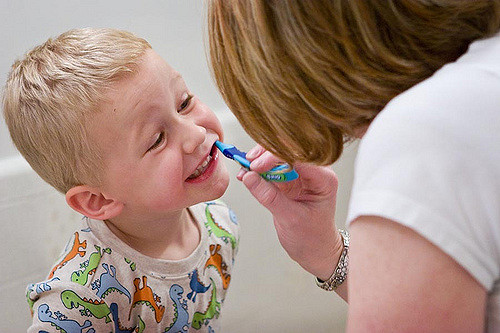
Tooth brushing is a good thing to pretend with a doll or stuffed animal. Bring a doll into the bathroom. After you finish brushing your child’s teeth, take an old toothbrush. Say “let’s brush dolly’s teeth.” Then help her hold the toothbrush and brush the doll’s teeth. If you brush your child’s teeth two times every day this will be another nice, simple routine that she is very familiar with. And it will also help her to establish good oral hygiene habits! And, if you pretend with a doll even one time each day, that should help her to get the idea of pretend play too.
What if your child does not like having her teeth brushed? It may help to count out the same number of brush strokes each time. This way, she will come to know what to expect. You could also sing a short tooth brushing song to her while you are brushing her teeth. Try to end the brushing when the song ends. (Search the internet for “tooth brushing songs;” there are lots!)
A few words about weighted blanket: Parents of children with ASD often ask about the usefulness of weighted blankets in helping to calm children, especially at bedtime. The evidence from research studies is not consistent. More important, the American Academy of Pediatrics warns that weighted blankets may restrict a baby’s breathing, lowering their oxygen levels, and even damaging their brain growth; it recommends against using them. If you want more information about weighted blankets for babies or toddlers, we suggest you discuss them with your pediatrician, or google the “American Academy of Pediatrics recommendations about weighted blankets”.