

Games For Diaper Changing And Dressing
1. HELLO AND GOODBYE FOR WORKING ON LANGUAGE
Diaper changing is a good time to work on more repetitive language games. For example, you could work on helping the child understand that “hello” means something or someone new coming into their environment. And, “bye-bye” means something or someone is leaving. For example, “Bye-bye wet diaper! Hello dry diaper! Bye-bye wet pants! Hello dry pants!”
You could do this in a little different way by giving a teddy bear or doll a diaper change using the same words. Be sure to reinforce these words with people. So, when daddy or grandma come in, make a big fuss “Here’s daddy! Hello daddy!” “Here’s Grandma! Hello Grandma!” And when they leave, “Grandma’s going in the car,” (or “Grandma is going home, bye-bye, Grandma!”). If you give your child lots of practice with hello and bye-bye, this will make it easier for her to get the idea. You can even reinforce this when throwing something in the trash – “Bye-bye juice-box, bye-bye tissue.”
2. THE PEEK-A-BOO GAME TO WORK ON EYE CONTACT AND SOCIAL ENGAGEMENT
Peek-a-boo is a great game for working on eye contact and social interaction any time of the day. If your child is still in diapers, you can use the diaper change as a chance to play peek-a-boo. Most children find it fun to see someone pop out from behind something to surprise them. You want your child to have lots and lots of experiences with you that are fun. Diaper changing time is great because it’s a time when you and your child will be face-to-face. There won’t be many toys that she can reach, so it may be easier to keep her engaged with you! Peek-a-boo also helps children to understand the idea that when something goes away, it doesn’t stop existing.

Let’s say your child is lying on her back ready to be changed. You can play peek-a-boo when you pull the diaper out of the box or diaper bag. Hold it up in front of your face and say, “Where did Mommy go?” Wait a few seconds, then pull the diaper up or down. With a happy look on your face, say, “There she is!” Do this a few times. You can also do this by putting the diaper (or blanket) in front of your child’s face and saying, “Where did baby go?” (Of course, you would use your child’s name instead of saying “baby”). Wait a few seconds, then pull the diaper or blanket down. With a happy look, say, “Oh there she is!” or “I found you!”
3. MINI-ROUTINES FOR TEACHING THE WORDS “STICKY, WET, OPEN” AND “BYE-BYE”
You could also work on some additional language, like ‘sticky’ (by letting the baby feel the “sticky” tabs on the diaper), or ‘wet’ (by letting her feel a “wet” wipe from the box) each time you change her diaper. Be sure to point out other things during the day that feel sticky or wet. And if your child is able to say some words, you could use the CLOZE (filling in) procedure to teach her to say these words by making a little routine out of it and then pausing and letting her fill in the blanks. For example, you could put your child’s finger on the sticky part of the tab and say, “The tab feels _________” then pause and see if she says the word, “sticky.” If not, try to prompt her by holding out the “s” sound like this, “Ssssss.” Of course, if she tries to say “sticky,” reinforce with praise (“nice talking! You said sticky!”).
Let your child be the one to open the trash can or throw a wet diaper into the trash while saying “bye-bye,” and later, “Bye-bye diaper!” or eventually, “Bye-bye wet diaper!” Your child will pay best attention to you during these times if she can predict and understand what is happening, and ultimately, play a role in the routine. So, try repeating these same routines and use the same language every time there’s a diaper change. This way, your child will get used to them and begin to understand more and more of the language you are trying to teach her.
4. SING THE DIAPER SONG TO WORK ON “WET,” “DRY,” “BYE-BYE,” AND “OPEN”
Making up silly songs for routines can be a great way to hold your child’s attention. An easy song would be something like this, sung to the tune of ‘Frère Jacques’. “Baby’s diaper, baby’s diaper now is dry, now is dry, now let’s take the old one now let’s take the old one and say bye-bye! Say bye-bye!” If you let her throw the old diaper in the trash or diaper pail, this would be a great song to sing just before you hand it to her so that she can toss it in.
If you want her to open the trash or diaper pail, ask her to “open please,” and then be prepared to prompt her to do what you have asked of her (by gently guiding her hand to open the pail). Then reinforce her enthusiastically using the word “open” again. You could say something like, ‘Yay! You opened it! What a helpful girl!’
5. UNDRESSING ROUTINE TO WORK ON SOCIAL ENGAGEMENT AND THE CONCEPTS OF “ON AND OFF” AS WELL AS THE WORDS FOR BODY PARTS
Try to turn undressing into a game in which you can teach some simple concepts. For example, some very good concepts to work on with undressing are ON-OFF, clothing items, and body parts. So, as you undress them, say “the sock is ON” then pull off the sock and say, “now it’s OFF!” “Oh it’s your little foot, I love your little foot!” And then swoop in for kisses or tickles to the foot!
When you put on your child’s shirt, say, “Shirt is ON,” then take off her shirt and say, “Shirt is OFF! Oh it’s your little belly, I love your little belly!” and aim the kisses and tickles to the belly. You can do this same routine for any article of clothing you remove. If you think your child is ready to try to say some words, say “hat is on” as you put it on her head or on your own head, then “hat is off.” Do this several times. Then after you put the hat on and say “hat is on,” make an exaggerated gesture to show you are taking the hat off, but pause before you say the word “off.” Hat is …..” If she doesn’t try to say “off,” you could prompt her with the first sound of the word off. “Hat is aw….” And if she still doesn’t try to say it, you finish it. If she does try to say it at any point, make a fuss, “Great talking!”
6. DRESSING ROUTINE TO WORK ON SOCIAL ENGAGEMENT AND THE WORDS FOR BODY PARTS
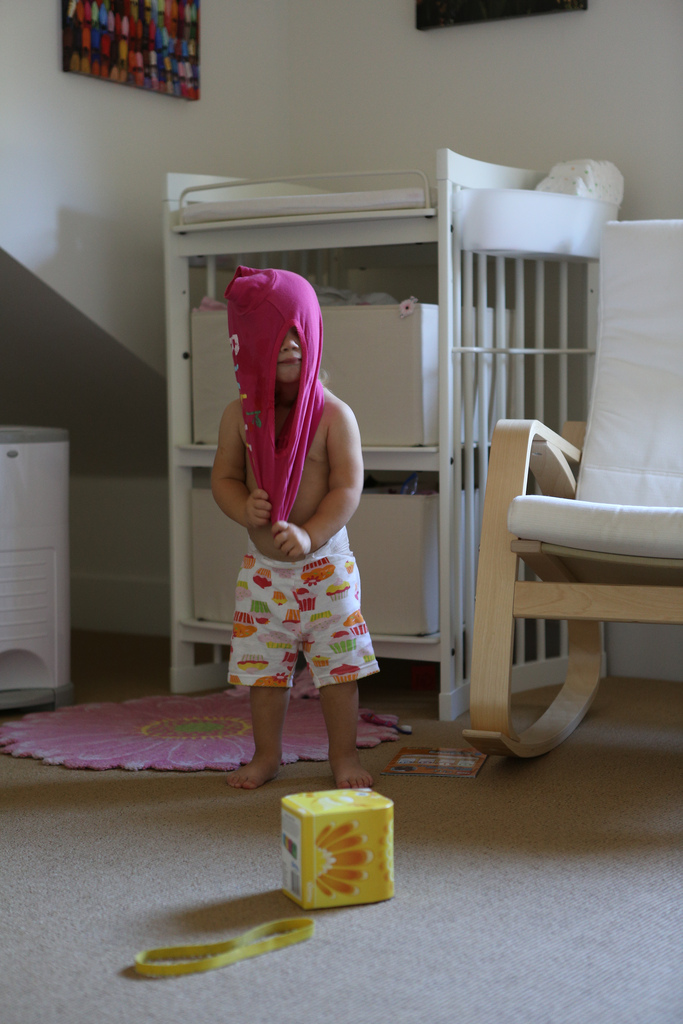
As you change your child’s clothing you can make it a hiding game. For example, you could say “Here come the PJs over baby’s head!” You can even fly the PJ top in like an airplane, and then as you put it over her head you could say, “Oh no! Where did baby go?” Then as you pull her head through, say “There she is! There’s my baby! But oh no! Where is baby’s arm? Where did it go?” and then as you pull her first arm through, say, “Oh there it is! There is baby’s arm!” and so on. If she’s still interested once she’s dressed, try to stretch it out even more by hiding mommy or dolly as they get dressed.